_edited.png)
AI Proposal Writing: A 5-Step System for Faster, Safer Sales Proposals

Updated: Sep 8

The fastest way to lose trust with AI proposal writing is to send a beautiful document that contains one invented promise.
The proposal may sound polished. The scope appears decisive. The timeline feels reassuring. Yet a model has quietly filled an empty space with an assumption: an integration you never confirmed, a result you cannot guarantee, a delivery date your team did not approve or a discount nobody authorized.
Speed did not create leverage. It moved the risk closer to the client.
AI proposal writing is the use of AI to organize verified discovery evidence, draft a clear offer and expose unresolved assumptions for human review. It should reduce blank-page time without taking authority over price, scope, legal terms, claims or the decision to send.
That job begins after qualification. If the prospect's problem, urgency or buying process is still unclear, repair the AI lead qualification workflow before asking a model to turn uncertainty into a proposal.
If you want to build this as a dependable business workflow instead of relying on one lucky prompt, Ben Angel's Zero-Employee Entrepreneur program teaches the deeper discipline: turn a commercial job into explicit inputs, hard permission limits and a result you can verify before it reaches a customer.
In This Article
What AI Proposal Writing Should Actually Do

Most bad proposals are not bad because the sentences are clumsy. They are bad because the document hides the distance between what the buyer said and what the seller assumed.
A useful AI-assisted proposal should make five things easier to see:
the buyer's stated problem, in their language
the evidence that the problem matters now
the proposed outcome and the work required to pursue it
the decisions, dependencies and exclusions that affect delivery
the price, approval path and next step a person has authorized
That is a very different task from “write me a persuasive proposal.” Persuasion without evidence encourages the model to decorate uncertainty. Evidence gives it something solid to organize.
The proposal also has a different commercial job from a ChatGPT sales page. A sales page explains one offer to many potential buyers. A proposal translates a specific, verified conversation into a bounded agreement for one buyer. Reusing sales-page language may help with clarity, but it cannot replace discovery, scope or approval.
The safest operating rule is simple: AI may accelerate expression; it may not manufacture agreement.
Build the Proposal Proof Stack

Before drafting, create a one-page Proposal Proof Stack. This is the evidence packet the model is allowed to use. It separates reliable inputs from gaps so missing information cannot quietly become confident copy.
Layer 1: The buyer's words
Capture the problem, desired outcome, urgency, objections and success criteria in the buyer's own language. Link each point to a call note, email, form response or approved record.
Do not summarize “they want growth” if the actual statement was “we need 30 qualified demos before the November event.” The second version can shape scope and measurement. The first invites generic promises.
Layer 2: The seller's verified facts
Add the approved service components, delivery capacity, price rules, relevant proof, standard terms and real constraints. Include only case-study results you can substantiate and explain the context around them.
An AI tool evaluation belongs here too. Know what the chosen product stores, which people can access the workspace, what data it may process and whether your current plan provides the controls you require.
Layer 3: The open decisions
List every item that still needs a human answer: final price, start date, service tier, payment schedule, named approver, legal clause, integration feasibility or delivery owner.
Mark these fields UNKNOWN—DO NOT INFER. A visible blank is safer than an elegant invention.
Layer 4: The permission boundary
State what the AI may and may not do. For example:
AI may organize the approved evidence and draft options. It may not change pricing, promise results, add deliverables, interpret legal terms, contact the prospect or mark the proposal ready to send.
This turns a vague productivity exercise into an auditable AI workflow. The boundary follows the proposal even if a different person or model handles the next revision.
The 5-Step AI Proposal Writing System

Once the Proof Stack exists, use this five-step system. Each step produces an artifact a person can inspect.
Step 1: Convert discovery into an evidence table
Create columns for buyer statement, source, commercial implication, confidence and unresolved question. Ask AI to extract only what is explicitly supported.
If the buyer said, “We lose leads because replies take two days,” the implication may be a response-time workflow. The model should not turn that into “the client loses $100,000 a year” unless a source supports the number.
Step 2: Separate confirmed, assumed and unknown
Require three labeled sections before any draft begins.
Confirmed items have a source. Assumed items are reasonable working hypotheses that need approval. Unknown items are missing and must remain blank or become questions.
This one move exposes the exact places where a proposal is likely to overreach.
Step 3: Draft the scope before the persuasion
Ask for a plain scope table first: outcome, deliverable, owner, dependency, timing, acceptance condition and exclusion.
Review that table with the delivery owner. Only then ask AI to shape the executive summary, problem statement and recommended approach. If the scope is wrong, improving the prose only makes the error harder to notice.
Step 4: Run three independent reviews
Use separate passes for:
Evidence review: Does every material statement trace to the Proof Stack?
Commercial review: Are price, margin, capacity and payment terms approved?
Risk review: Are claims, privacy, security, legal language and dependencies accurately bounded?
Do not ask one prompt to draft and certify its own work. That is the proposal equivalent of letting the salesperson approve their own discount.
Step 5: Create the approval packet
The final packet should contain the proposal, a short change log, unresolved items, source links and an explicit “not sent” status. A named human approves the final version and performs the external send.
Measure the workflow after real use. Track drafting time, review time, correction count, turnaround time and win/loss notes. The same principle behind measuring AI automation ROI applies here: the value is not how quickly the first draft appeared. It is whether verified time was saved without increasing rework, risk or customer confusion.
After the sale, use these AI customer retention workflows to monitor onboarding friction, support patterns and renewal risk without automating consequential customer decisions.
A Prompt That Produces a Reviewable Proposal
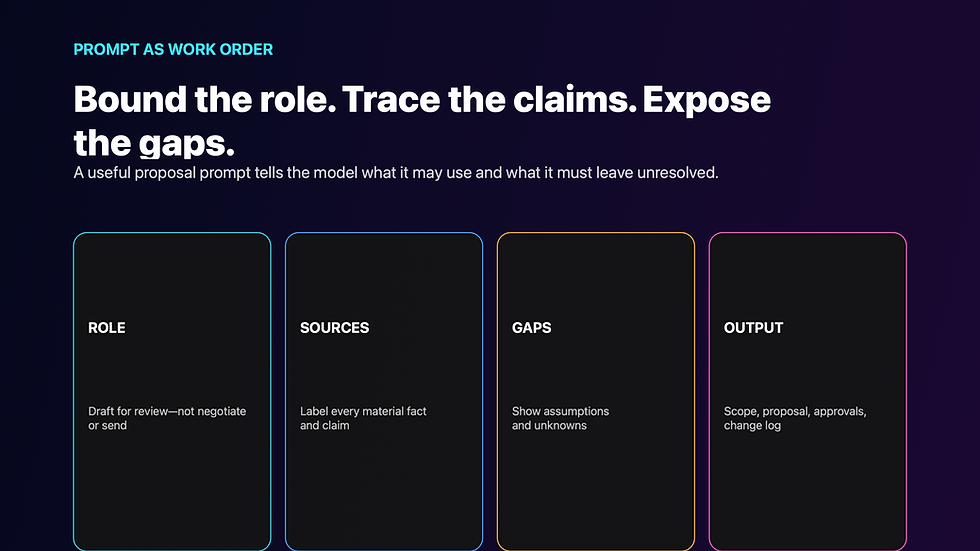
A good proposal prompt behaves more like a work order than a creative brief.
Give the model a bounded role
Tell it that it is preparing a draft for review, not negotiating, approving or sending. Name the intended reader, the decision the proposal should support and the evidence packet it may use.
Require traceability
Ask the model to attach a source label to every material buyer fact, result claim, deliverable, price and timeline. If a sentence has no source, it must be labeled as an assumption or removed.
Force the gaps into view
Use this reusable instruction:
Using only the Proposal Proof Stack below, prepare a proposal draft for human review. First return Confirmed, Assumed and Unknown tables. Then draft the scope table and proposal. Do not invent buyer intent, results, price, dates, deliverables, integrations, legal terms or proof. Add a source label to every material claim. End with an Approval Required list and a change log. Do not contact the prospect, update any record or mark the proposal ready to send.
Then paste only the minimum necessary information. Redact personal, confidential or commercially sensitive data that the model does not need.
OpenAI states that data submitted to its business products and API is not used to train models by default, but that is a product-specific policy—not blanket permission to upload a prospect's confidential material. Check the exact product, plan, retention settings, contract and your own obligations before using sensitive information. OpenAI's business data privacy page provides the current vendor policy; your business still owns the decision about what should be shared.
What the ICG Case Shows—and What It Does Not

Microsoft published a customer story in April 2025 about ICG, a five-person consulting firm that prepares complex consulting proposals.
According to the Microsoft ICG customer story, the firm used Microsoft 365 Copilot to search and summarize material across its existing work, then accelerate proposal preparation. Microsoft reports that ICG reduced proposal response time by 80%.
The useful mechanism
The case is relevant because the team did not describe AI as a substitute for consulting judgment. Copilot helped retrieve and rework institutional knowledge that already existed across the firm's documents. For a small business, the transferable mechanism is retrieval plus drafting against an approved evidence base.
That mechanism becomes stronger when the inputs are structured: named sources, current proof, approved scope components and visible gaps.
The evidence boundary
The 80% figure is a vendor-published, self-reported outcome from one five-person consultancy using a particular Microsoft environment. The story does not provide a controlled comparison, a proposal-quality score or a universal win-rate result. It should not become the promise in your own proposal.
Treat it as evidence that a bounded knowledge-and-drafting workflow can reduce response time in one real setting—not proof that any AI tool will make every proposal 80% faster.
What AI Should Never Decide Alone

Proposal work touches money, delivery capacity, customer data and contractual expectations. Those are consequential decisions.
AI may prepare
AI may extract supported facts, compare approved options, draft language, identify contradictions, build checklists and surface missing information. It can also generate questions for the proposal owner.
A person must approve
A named person must approve:
the final price, discount and payment terms
the promised outcome and supporting proof
scope, exclusions, dates and resource commitments
privacy, security and legal language
any external send, signature request or record change
NIST's Generative AI Profile frames generative-AI risk management around governance, measurement and managed controls. For a proposal workflow, the practical translation is traceable sources, explicit authority, testing against real use and human accountability at the point of commitment.
If several people prepare or approve proposals, document the rule in an AI policy for small business. The policy does not need to be theatrical. It needs to say who may use which system, which data is prohibited and who owns the send decision.
Before You Send Another Proposal

I understand the seduction of speed. When a prospect is waiting, the blinking cursor feels like the bottleneck. AI can make that cursor disappear in seconds.
But the cursor was never the expensive part.
The expensive part is committing to work you did not price, repeating a claim you cannot prove or sending a document so generic that the prospect cannot recognize their own problem inside it.
My rule is: never let AI make a proposal sound more certain than the evidence.
That same human-versus-automation tension runs through my book, The Wolf Is at the Door: the advantage is not surrendering judgment to technology, but knowing which judgment becomes more valuable because the technology exists.
Build the Proof Stack first. Make the unknowns visible. Draft the scope before the persuasion. Require independent evidence, commercial and risk reviews. Then let a person decide whether the document deserves to leave the business.
If you want to practice that operating discipline across more than proposals, Ben Angel's Zero-Employee Entrepreneur program helps you build one useful AI capability at a time—with clear inputs, permission boundaries and verification.
The goal is not to become the fastest business at producing PDFs. It is to become the business that responds quickly without making trust expensive.
AI Proposal Writing FAQs

Can ChatGPT write a business proposal?
Yes. It can organize approved evidence, draft sections and identify gaps. A person must still verify the buyer facts, claims, scope, price, dates, legal language and final send.
What information should I give an AI proposal tool?
Provide the minimum necessary buyer evidence, approved offer details, constraints and source links. Remove unnecessary personal or confidential data, and mark every unresolved field unknown rather than inviting the model to infer it.
How do I stop AI from inventing proposal details?
Use a closed evidence packet, require Confirmed, Assumed and Unknown tables, demand source labels for material claims and run a separate evidence review. No prompt eliminates error, so human verification remains required.
Should AI set proposal pricing?
No. AI can compare approved price options or calculate totals using rules you supply. A person with authority over margin, capacity and commercial terms should approve the final price.
Is client information safe in an AI proposal generator?
That depends on the vendor, product tier, settings, contract and information involved. Review current data-use and retention terms, use the minimum data required and follow your client agreements and applicable obligations.
How should I measure an AI proposal workflow?
Track total drafting and review time, material corrections, turnaround time, scope changes after approval and win/loss notes. Measure the verified process, not merely how fast the model returned text.


Comments