_edited.png)
Do AI Course Certificates Matter? What Employers, Clients and Entrepreneurs Actually Value


You finish an AI course, download the certificate and feel the brief relief of having something official to show for the work. Then the harder question arrives: do AI course certificates matter enough to change a hiring decision, win a client or justify the price of the course?
The direct answer is: an AI course certificate can strengthen your credibility, but it rarely closes the decision by itself. It matters most when a credible issuer, a real assessment and an applied piece of work sit behind it. A certificate without evidence is a claim. A certificate attached to a useful workflow, campaign, analysis or product becomes a signal people can inspect.
That distinction matters because the market is moving in two directions at once. Employers say AI skills are increasingly important, while skills-first hiring places more weight on practical capability than on a new line in the education section. Clients are even less interested in the paper. They want to know whether you can improve a decision, protect their data, save time or create measurable value.
My rule is simple: a certificate opens the conversation; proof earns the decision.
If you want the learning to produce something more valuable than a badge, Ben Angel's 28-Day AI Mastery course is designed to help you turn AI knowledge into practical business systems, clearer decisions and work you can actually demonstrate.
In This Article
The Direct Answer: When an AI Certificate Matters
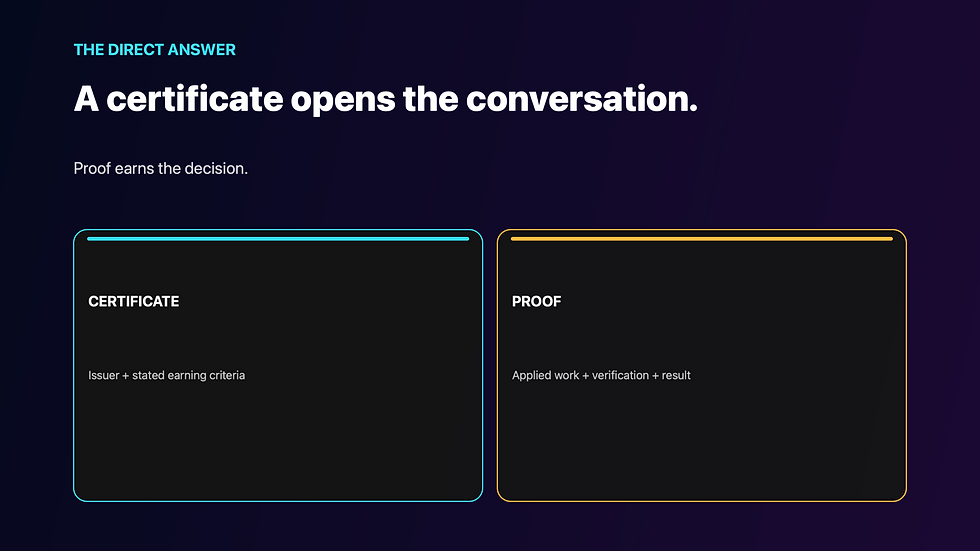
An AI certificate matters when it reduces uncertainty for the person evaluating you. It should answer four questions quickly: Who taught this? What did you have to do? Can the result be verified? What can you now do that creates value?
The first three questions establish legitimacy. The fourth establishes relevance.
A certificate is most useful when you are entering AI from another field, pitching work to a cautious buyer, applying for a role that explicitly asks for AI literacy or documenting structured professional development. It gives the evaluator a simple signal that you did more than watch a few random videos.
It matters less when the issuer is unknown, completion is based only on attendance, the material is already out of date or you cannot show how the learning changed your work. In those cases, the certificate may record effort without demonstrating capability.
Think of the certificate as the label on a box. The evaluator still wants to open the box.
For a job seeker, the contents might be an AI-assisted market analysis with sources and a clear review process. For a marketer, it might be a campaign workflow with approved inputs, quality checks and conversion evidence. For an entrepreneur, it might be a repeatable operating system that saves five hours a week without giving AI silent authority to publish, pay or delete.
This is why the debate is not really certificate versus no certificate. It is certificate alone versus certificate plus proof.
If you are still deciding how structured training compares with self-directed learning, read AI Course vs YouTube: Which Is Better for Learning AI?. If price is the bigger question, Free AI Courses vs Paid AI Courses separates access from accountability, sequence and implementation.
What an AI Course Certificate Actually Proves
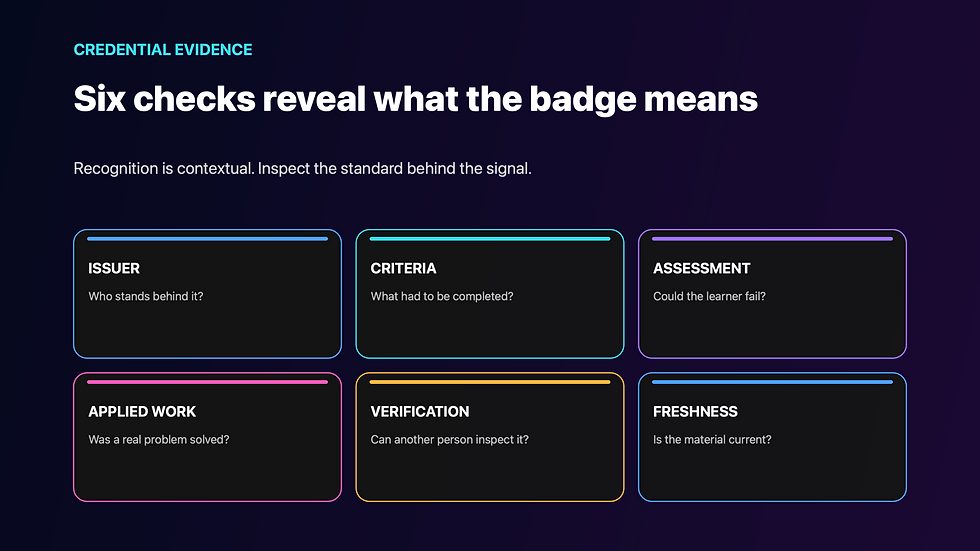
A certificate can prove that a named organization recognizes that you met its stated requirements. Depending on the course, that may include attendance, quizzes, a final assessment, a capstone or demonstrated work.
It does not automatically prove independent expertise, current knowledge, business judgment or future performance.
That is not a criticism. It is simply the evidence boundary.
Strong certificates tell the evaluator what happened behind the badge. Look for:
A named issuer with a reputation it has an incentive to protect.
Published earning criteria rather than vague claims of “mastery.”
An assessment that can be failed, not only a completion button.
Applied work that resembles a real business problem.
A verifiable credential page with the earner, issuer and date.
Current content and a clear process for updates.
Weak certificates often reverse that order. The badge receives more attention than the learning standard. The sales page promises transformation, but the earning criteria amount to watching the lessons.
This is where course buyers get trapped. They ask whether the certificate is “recognized” as though recognition were a universal stamp. Recognition is contextual. A cloud certificate from the platform vendor may be useful for a technical role. A broader AI literacy certificate may help an employer see structured learning. A business owner may care less about either one than about whether you can build a safe customer-research workflow.
The question to ask is not, “Will everybody recognize this?” Ask, “Which decision is this credential supposed to support, and what additional proof will that decision-maker need?”
You can use my guide to the best AI courses for beginners to compare course structure, but keep the outcome visible: learning should change the quality, speed or safety of your work.
The Credential-to-Capability Stack

I use a five-part framework called the Credential-to-Capability Stack. It turns an abstract credential into a credible business story.
1. Issuer
Who stands behind the certificate? A known university, platform company, professional body or specialist with a visible track record can supply an initial trust signal. Reputation is useful, but it is not a substitute for the remaining layers.
2. Assessment
What did you have to pass? A timed exam, evaluated project or capstone tells the evaluator more than passive completion. The standard should be visible enough that another person can understand what the badge represents.
3. Applied artifact
What did you build with the learning? This can be a workflow map, prompt library, analysis, dashboard, research brief, automation prototype or policy. Remove confidential data and show the problem, inputs, decisions, safeguards and result.
4. Verification
Can somebody verify the credential and inspect the work? Link the badge to its issuer page. Link the artifact to a short case study or portfolio entry. Explain what you personally did and where AI assisted.
5. Business outcome
What changed? Good outcomes can include shorter review time, fewer errors, faster customer insight, a clearer decision or a safer process. Do not manufacture revenue attribution. If you only measured time or quality, say that.
The stack works because each layer answers a different objection. The issuer answers, “Is this legitimate?” The assessment answers, “Was it earned?” The artifact answers, “Can you apply it?” Verification answers, “Can I inspect the claim?” The outcome answers, “Why should I care?”
This is also the difference between collecting courses and building capability. The AI skills entrepreneurs need include judgment, workflow design, evidence checking and approval discipline—skills that travel across tools even when the certificate title changes.
What Employers Actually Look For

The strongest current evidence points to a blended answer: employers want AI capability, but a certificate is only one way to signal it.
The World Economic Forum's Future of Jobs Report 2025 surveyed more than 1,000 employers globally. It found that 63% saw skills gaps as a major barrier to business transformation, 85% planned to prioritize upskilling and 62% planned to hire people with skills to work with AI. Yet only 14% said they expected to consider online certificates in hiring by 2030.
That does not mean certificates are worthless. It means the hiring signal is shifting toward demonstrable skills, work experience and skills-first evaluation.
LinkedIn's 2025 Skills Signal report reached a similar practical conclusion. Its platform analysis found that workers matched by skills rather than titles could qualify for more roles, and it recommends connecting skills to projects, roles and measurable accomplishments. LinkedIn also reported that skills-based searches were more likely to lead to high-quality hires.
Both sources have limits. The WEF report captures employer expectations, not a controlled record of future hiring decisions. LinkedIn's evidence is drawn from its own platform and includes correlational findings; it cannot prove that adding a skill or certificate caused a person to be hired.
Even so, the direction is clear. Employers are more likely to believe a skill when they can see where you used it.
Build a one-page proof note for each meaningful project:
Problem: what business decision or workflow needed improvement?
Evidence: which sources or data did you use?
Method: what did AI do, and what did you do?
Boundary: what required human review or specialist approval?
Result: what changed, and what did you actually measure?
Learning: what would you improve in the next run?
That note is more persuasive than claiming to be an “AI expert.” It gives an interviewer material for a serious conversation and shows that you understand both capability and risk.
For people learning independently, How to Learn Artificial Intelligence Online explains how to create structure around scattered resources. Whatever route you choose, finish with evidence that can leave the course platform.
What Clients and Customers Need to See

Clients rarely buy education. They buy reduced uncertainty.
A small-business owner deciding whether to hire you wants to know whether you understand the problem, whether your process is safe and whether the expected value exceeds the cost. The certificate can support trust, particularly when AI feels unfamiliar or risky. But it will not replace a clear offer and a credible demonstration.
Suppose you completed a marketing-focused AI course. “Certified in AI marketing” is a broad signal. A stronger proof package might show:
A customer-review synthesis using approved public data.
The prompt and workflow used to classify recurring objections.
A sample campaign brief connected to those objections.
The human review checklist used before publication.
A measured reduction in research or revision time.
A clear statement that no sales outcome has yet been attributed.
Now the client can evaluate a mechanism instead of a label.
The same principle applies inside your own business. An entrepreneur does not need a certificate to impress a hiring manager. You may use it to impose sequence, deadline and accountability on your learning. Its value appears when the learning produces a better system.
That system should also have permission boundaries. A trained AI assistant may prepare recommendations, classify information or draft an asset. It should not silently receive authority to publish, send, purchase, delete or make a binding decision. My AI policy for small business gives you a starting point for separating capability from authority.
This is Ben doctrine in practice: learning proof should travel in pairs—the credential and the work it changed.
The IBM SkillsBuild Case Study—and Its Limits

The IBM SkillsBuild Artificial Intelligence Certificate is a useful named example because the earning criteria are visible.
On the IBM-issued credential page hosted by Credly, IBM describes an advanced certificate involving learning activities, capstone projects and a final assessment. The listed capabilities include applying AI concepts to practical solutions and considering ethical and governance issues.
This gives the badge more evidentiary value than a generic completion certificate. A potential employer or partner can see the issuer and the stated standard. The capstone requirement also creates the possibility of an applied artifact.
But the case study has important limitations:
The credential page describes IBM's own earning criteria; it is not an independent evaluation of graduate performance.
Completion does not prove that every earner can solve an unfamiliar business problem.
The page does not report hiring, salary, client or revenue outcomes.
Access can depend on a partner organization or academic institution, so availability is not universal.
The responsible conclusion is that IBM supplies a strong initial signal and a structured path to applied work. The capstone—not the logo alone—is where a learner can begin turning the certificate into proof.
If you earned it, do not stop at “IBM-certified.” Show the sanitized capstone, explain the decisions you made and describe how you checked the result. If the work never left the course environment, adapt the same method to a real problem you have permission to solve.
The evidence boundary protects you as much as the audience. It keeps a credible credential from being weakened by inflated claims.
How to Turn a Certificate Into Business Proof in 28 Days
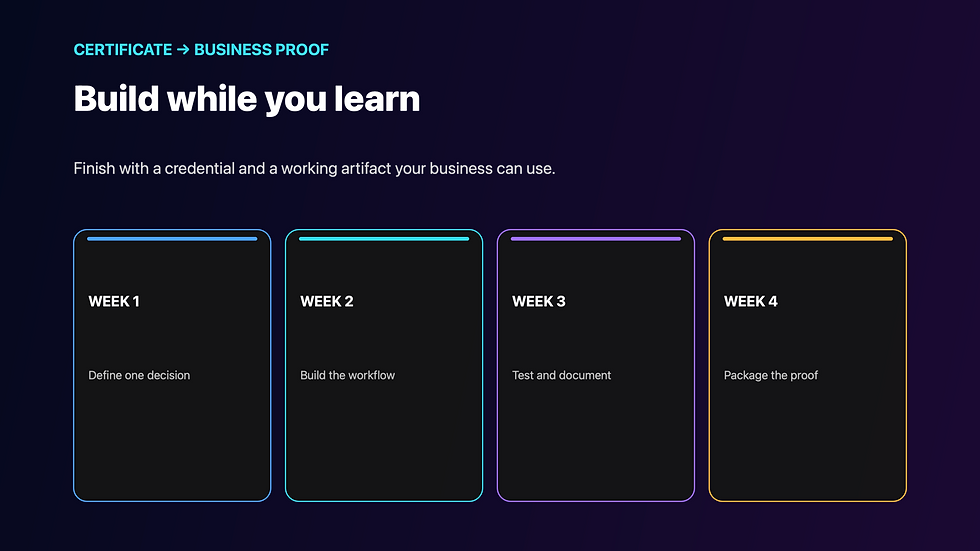
The fastest way to improve the value of a certificate is to choose one recurring business problem and build through it while you learn.
Week 1: Define the decision
Choose a narrow result: reduce the time required to summarize customer interviews, improve the consistency of campaign briefs or create a safer research workflow. Write a definition of done and list the information AI may and may not use.
Week 2: Build the first workflow
Map the input, AI task, human judgment, output and approval point. If you need a model, start with what an AI workflow is. Keep the first version reversible and small enough to test in an hour.
Week 3: Test and document
Run the workflow on a real but low-risk example. Record time, errors, corrections and review effort. Save the prompt or instructions, but do not pretend the prompt is the whole system. The evidence and review standard matter just as much.
Week 4: Package the proof
Create a short case study with the problem, process, boundary, artifact and measured result. Link the verifiable certificate. Remove confidential details. State what the evidence does not prove.
This is the practical conversion job inside Ben Angel's 28-Day AI Mastery course: bring a real goal, build the working system around it and finish with something your business can use—not another tab of lessons you intend to revisit later.
The course does not make a certificate magical. It makes implementation the standard. That is what allows learning to survive contact with the real world.
Before investing, you can also use an AI cost audit for small business to compare the course price with the cost of fragmented tools, repeated mistakes and unstructured experimentation. Count the value of a certificate only where it reduces risk or helps produce verified work.
Before You Pay for Another Credential

I understand the relief a credential can create. It turns an uncertain learning journey into something visible. But when the technology changes this quickly, visible activity can feel like progress long after it has stopped improving your decisions.
That is one reason I wrote the bestselling The Wolf Is at the Door. The durable advantage in this transition will not belong to the person with the longest list of tools or badges. It will belong to the person who can connect new capability to evidence, judgment and responsible action.
Before you buy another credential, ask:
Which decision should this certificate help somebody make?
What assessment sits behind it?
What applied artifact will I finish?
How will another person verify the claim?
Which result can I measure honestly?
If the course cannot help you answer those questions, the badge may become expensive decoration.
A strong certificate can open a door. Walk through it carrying proof.
AI Course Certificate FAQs

Do AI course certificates matter to employers?
They can help signal structured learning, especially for people moving into AI from another field. Current employer evidence places more weight on practical skills and experience, so attach the certificate to relevant projects and measurable accomplishments.
Can an AI certificate get me a job?
No certificate can guarantee a job. A credible credential may help you pass an initial screen or support an interview, but role fit, experience, communication and demonstrated work still shape the decision.
Are free AI certificates worth it?
They can be worthwhile when the issuer, curriculum and assessment are credible and the course helps you build useful work. “Free” does not make a certificate weak; unclear earning criteria do.
Which AI certificate is most recognized?
Recognition depends on the role and evaluator. Platform-specific credentials may matter for technical jobs using that platform, while broader certificates may support AI literacy. Inspect job descriptions and speak with people making the relevant decision.
Do clients care about AI certifications?
Some clients value the reassurance, but most care more about whether you understand their problem and can demonstrate a safe, useful process. Treat the certificate as supporting evidence, not the offer itself.
Should entrepreneurs take certified AI courses?
Yes, when structure, accountability and assessment will help them implement faster. The business value should appear in a working process, a better decision or a measurable improvement—not only in the certificate.
How should I put an AI certificate on LinkedIn?
Link the verifiable credential, name the issuer and add the most relevant skills. Then connect those skills to a project or role with a specific, honest result. Avoid inflated titles such as “AI expert” when the evidence supports a narrower capability.


Comments