_edited.png)
AI Skills for Entrepreneurs: 7 AI Skills That Survive Updates


There is a particular kind of frustration that arrives after you become “good at prompting.” The answers improve, yet the business does not feel fundamentally easier to run.
That happens because the most valuable AI skills for entrepreneurs now extend beyond writing instructions. Commercial advantage comes from choosing the right problem, supplying trusted context, judging the result and turning one successful experiment into a repeatable system.
Quick answer: The seven essential AI skills for entrepreneurs are use-case selection, context design, output evaluation, workflow design, information protection, human-AI judgment and impact measurement. Together, they help an owner convert AI from a helpful writing tool into reliable business capability.
The skills gap is becoming more important as access spreads. In its survey of more than 5,000 SMEs, the OECD found that twice as many users said generative AI increased the need for highly skilled workers as said it decreased that need. Data analysis, interpretation, creativity and innovation were among the capabilities becoming more important.
That finding should change how entrepreneurs learn AI. Prompting is useful, but it is closer to learning how to speak to a talented contractor. You still need to choose the assignment, provide the right materials, recognize weak work and decide what should happen next.
The 28-Day AI Mastery Course is designed to build that practical stack through business application rather than abstract technical study. This article gives you the roadmap.
In This Article
Why Prompting Is No Longer Enough
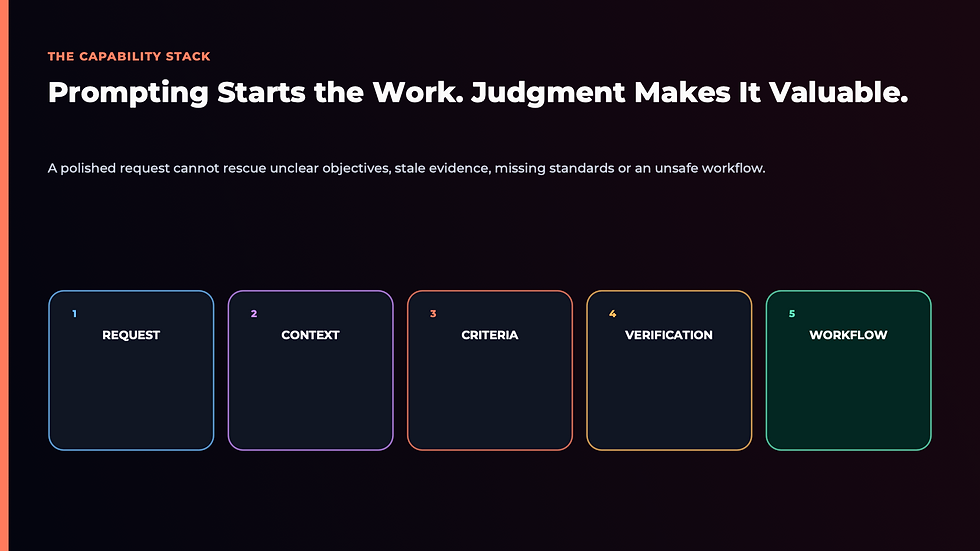
Prompting teaches you to request a result. Business capability requires you to build the conditions that make the result trustworthy and repeatable.
Imagine handing a chef a beautifully worded order. If the ingredients are stale, the kitchen is disorganized and nobody knows what “ready” looks like, elegant phrasing will not rescue dinner service.
AI works the same way. A strong prompt cannot compensate indefinitely for:
an unclear business objective
contradictory customer information
missing examples
no quality standard
unsafe access
a workflow that ends in somebody manually repairing everything
That is why my guide to building an AI loop focuses on criteria, iteration and stopping rules rather than one perfect instruction.
Prompting gets work started. Judgment makes the work valuable. Systems make the value repeatable.
The Seven AI Skills for Entrepreneurs
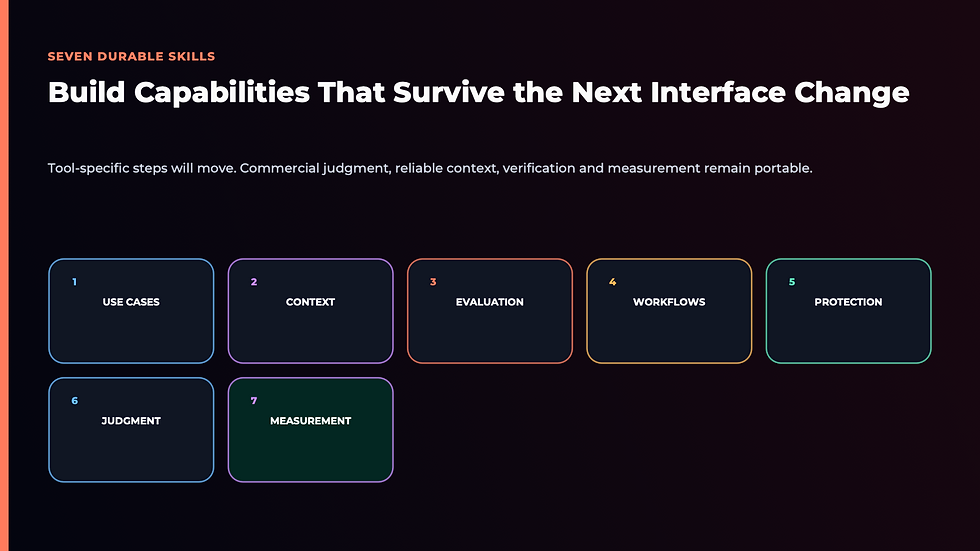
1. Identifying commercially valuable use cases
The first skill is seeing where AI can change an outcome rather than merely decorate a task.
Ask:
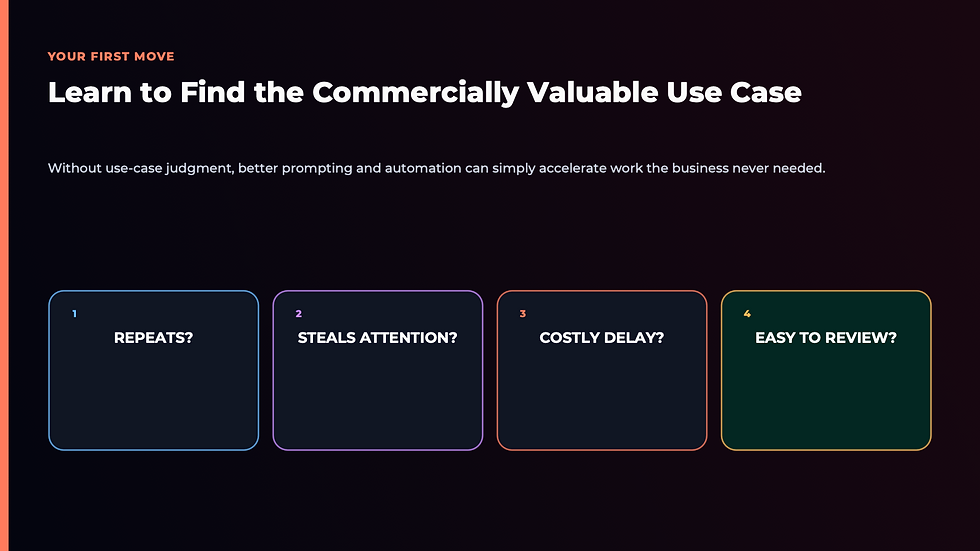
What repeats?
What steals attention?
What becomes expensive when delayed?
What can be checked before it affects a customer?
A founder who automates caption variations may save minutes. A founder who uses AI to surface warm leads waiting for follow-up may recover revenue. This AI automation guide provides a practical scoring method.
2. Supplying reliable business context
General intelligence produces general work until it can consult your actual business.
Build a small context set containing the current offer, customer evidence, approved examples, operating rules and current priorities. The objective is not to upload everything. It is to make the right facts available for the job.
My five-step guide to building an AI brain shows how to create that portable business library without coding.
3. Evaluating AI output
AI literacy includes recognizing when confident work is weak.
Create a scorecard before asking for the output. For a sales email, assess promise, specificity, evidence, audience fit, tone, exclusions and next action. For analysis, check source coverage, calculations, uncertainty and alternative explanations.
The question is not “Do I like this?” It is “Does this meet the standard, and can I show why?”
4. Designing repeatable workflows
A useful result becomes valuable when you can produce it again without reconstructing every step.
Document:
the trigger
required inputs
source hierarchy
task stages
quality tests
approval boundary
final destination
This is the difference between using AI and building an asset. A well-designed ChatGPT Goal can preserve the desired outcome for a multi-stage assignment, but the entrepreneur still defines success.
5. Protecting business and customer information
Useful AI systems often need context. That makes information judgment a commercial skill.
Classify information before sharing it:
public and approved
internal but low risk
confidential
regulated or highly sensitive
Use minimum necessary access, check current product controls and keep high-consequence actions behind approval. The NIST AI Risk Management Framework provides a broader structure for managing AI risk over time.
6. Combining human judgment with automation
Do not ask, “Human or AI?” Ask, “Which part requires speed, and which part carries consequence?”
AI can collect evidence, compare options, draft scenarios and expose inconsistencies. The entrepreneur remains responsible for positioning, trust, ethical boundaries, customer relationships and decisions where the evidence is incomplete.
This is especially important as tools such as ChatGPT Work take on longer assignments. More capability increases the importance of a clear approval architecture.
7. Measuring time, revenue and decision quality
The final skill is distinguishing impressive activity from improvement.
Track:
total time from request to approved completion
correction rounds
delays removed
leads recovered
conversion or revenue influenced
error and risk incidents
decisions made faster or with stronger evidence
If the workflow creates more output but no measurable change in time, revenue, quality or risk, it remains an experiment.
The AI Skills Gap Scorecard
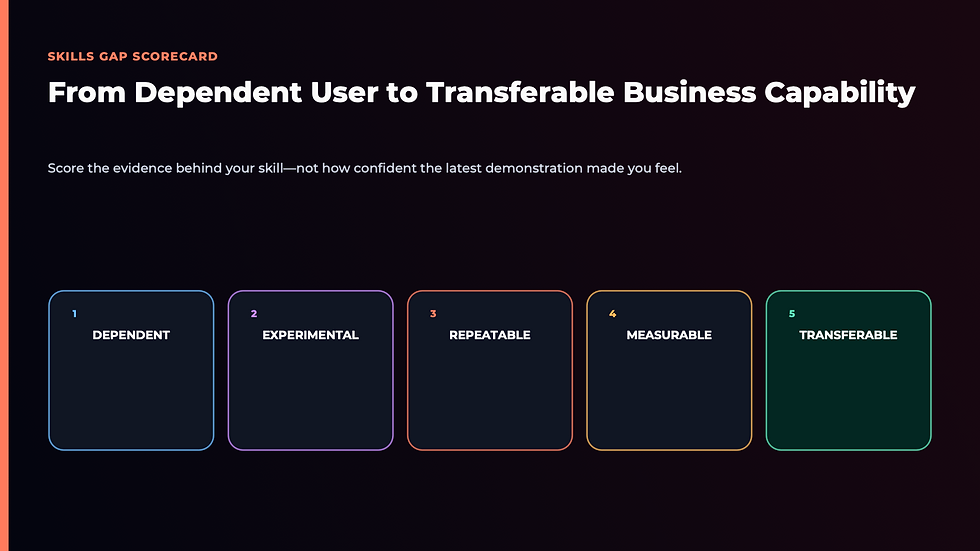
How capable is your business with AI beyond writing prompts?
Rate yourself from 1 to 5 on each of the seven skills above:
Choosing valuable AI use cases
Providing reliable business context
Evaluating AI output
Designing repeatable workflows
Protecting business information
Combining AI with human judgment
Measuring the business impact
Use this scale for each skill:
1 — Dependent: I need a tutorial or outside help every time.
2 — Experimental: I can get a result, but the process is inconsistent.
3 — Repeatable: I can produce the result again using documented steps or a checklist.
4 — Measurable: I can show how the process improves time, quality, revenue or risk.
5 — Transferable: Another person—or an AI tool—can follow the documented system safely without relying on me to rebuild it.
For example, you might score yourself:
Choosing valuable use cases: 4
Providing business context: 3
Evaluating AI output: 3
Designing workflows: 2
Protecting information: 2
Combining AI with human judgment: 4
Measuring impact: 1
Your total would be 19 out of 35.
What Your Total Score Means
Now add your seven scores:
7–14 — Output Collector: You can use AI, but each result still depends heavily on tutorials, improvisation or manual correction.
15–24 — Active Experimenter: You have useful results, but your processes are not yet consistent or measurable.
25–30 — Workflow Builder: You are creating repeatable systems. Your next priority is improving measurement, documentation and risk controls.
31–35 — Capability Builder: Your AI systems are measurable, documented and transferable. Continue testing them as tools and business conditions change.
Your total shows the overall maturity of your AI use.
But your lowest individual score is more important: it identifies the capability most likely to limit everything else.
Choose that skill and spend the next 30 days improving it by one level.
How to Practise These Skills in 30 Days
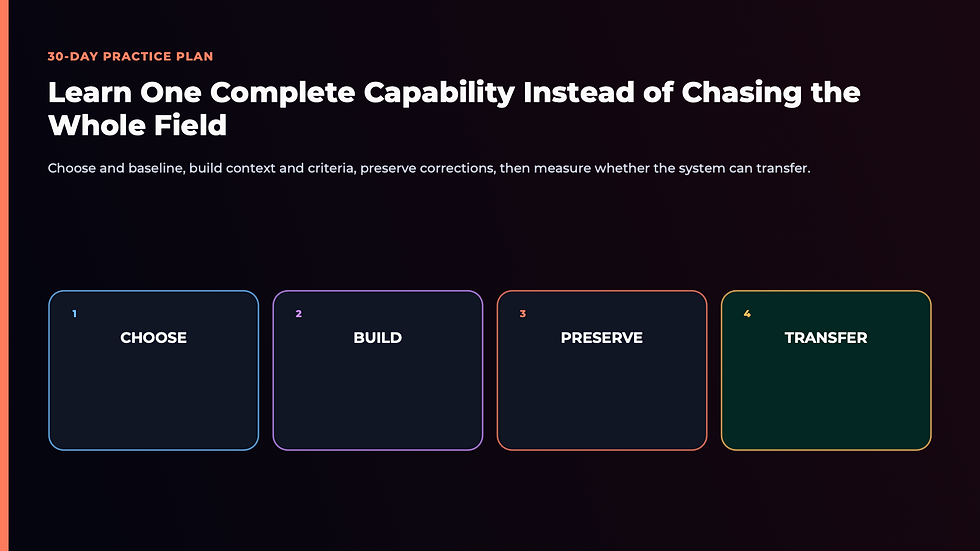
Do not try to “learn AI” as one giant subject. Build one complete capability.
Week 1: Choose and baseline
Select one repeated outcome such as customer-feedback analysis, campaign briefing or weekly reporting. Record the current time, errors and handoffs.
Week 2: Build context and criteria
Gather five trusted sources. Create a one-page scorecard defining acceptable work, prohibited claims and human-review points.
Week 3: Run, review and preserve
Complete the workflow three times. Turn every repeated correction into an instruction, template or example.
Week 4: Measure and transfer
Compare the result with the baseline. Ask whether another capable person could run the workflow from your documentation. If not, identify the missing judgment.
You can use YouTube for a current feature demonstration or a narrow obstacle. For a connected learning path, this AI course versus YouTube comparison explains why sequencing and implementation support matter.
What Entrepreneurs Should Not Outsource to AI
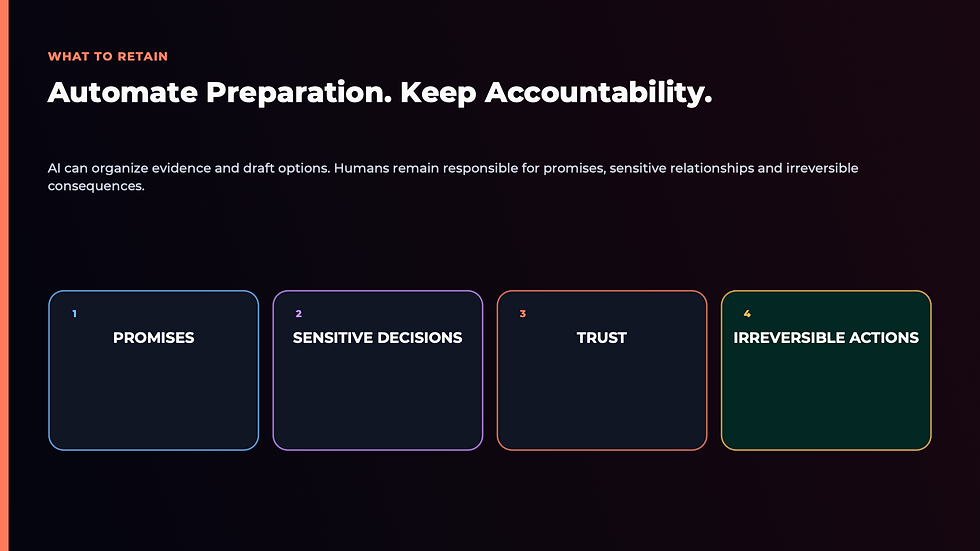
The strongest AI skill may be knowing what to retain.
Keep direct human responsibility for:
the promise your brand makes
legal, financial, medical and employment decisions
final claims about customers or competitors
emotionally sensitive customer conversations
access to confidential information
irreversible actions
the interpretation of ambiguous evidence
AI can prepare these decisions. It can surface the facts, draft options and identify trade-offs. Preparation is not abdication.
The OECD found that 83% of surveyed SME users reported no change in overall staffing need from generative AI. That does not prove the future will be stable. It does suggest that the immediate story is often task redesign and skill change rather than wholesale replacement.
A Personal Note About Becoming Harder to Replace

You may have opened this article expecting seven tools or seven technical tricks. I understand the appeal. Tools feel concrete, and a new feature can create an immediate burst of progress.
But tools are rented. The ability to see the right problem, organize the evidence and make a sound decision belongs to you.
Your safest advantage is not knowing every AI feature. It is becoming the person who can turn changing features into durable business capability.
That belief sits underneath my work as an author and entrepreneur. I have watched platforms, traffic sources and business models change for more than two decades. The people who adapt best are rarely those who memorized the previous interface. They built judgment, focus and a way to learn under pressure.
That is the larger challenge I explore in The Wolf Is at the Door: technology receives an upgrade, and we must decide what to strengthen in ourselves.
Choose the lowest score in your AI Skills Gap Scorecard. Build evidence that it improved over the next 30 days. The 28-Day AI Mastery Course gives you the structured path to practise these capabilities inside real entrepreneurial work.
Frequently Asked Questions
What AI skills do entrepreneurs need?
Entrepreneurs need use-case selection, context design, evaluation, workflow design, information protection, human-AI judgment and measurement skills. Technical coding is optional for many small-business applications.
Is prompting still an important AI skill?
Yes, but prompting is one part of a larger capability. A strong instruction still needs reliable context, clear criteria, verification and a useful place inside the business workflow.
Do entrepreneurs need to learn coding?
Most entrepreneurs can create valuable AI workflows without coding. Coding becomes useful for custom integrations, specialized products and advanced automation, but it is not the default entry requirement.
How long does it take to learn practical AI skills?
A focused business workflow can be learned and improved within several weeks. Broader mastery is ongoing because models, products and business conditions continue to change.
Which AI skill should I learn first?
Learn to identify a commercially valuable use case. Without that skill, better prompting and automation can simply accelerate low-value work.
How much does AI training cost?
Costs range from free documentation and videos to paid courses, memberships and specialist training. Compare total cost, including search time, abandoned learning and delayed implementation.
Will AI skills become outdated?
Tool-specific steps will change. Judgment, context design, verification, workflow thinking, information protection and measurement are more durable because they apply across platforms.
Can AI skills help a one-person business compete with larger firms?
They can help a solopreneur access capabilities, reduce workload and make faster decisions, but they do not remove the need for a strong offer, customer trust and sound commercial judgment.


hi 88 mình thấy mọi người nhắc hoài nên bấm vô coi thử cho biết chứ cũng không có ngồi đọc kỹ hay làm gì nhiều. Vừa vào cái là thấy giao diện nhìn khá nhẹ mắt, khoảng trắng vừa đủ nên không bị ngộp. Mấy mục trên trang được chia theo cụm rõ ràng, kiểu lướt một cái là biết chỗ nào là chỗ nào, không phải căng mắt tìm. Mình cũng để ý cái menu đặt khá dễ thấy nên bấm qua lại vài trang rất nhanh, không bị vòng vèo. Nói chung cảm giác họ làm gọn gàng, nhìn “sạch” kiểu hiện đại. Đặc biệt mấy khối thông tin dạng cột ô xếp thẳng hàng nên liếc…
Mình hay xem soi cầu XSMB với soi cầu miền Bắc mỗi ngày để kịp cập nhật trước lúc quay số, chủ yếu để có thêm góc nhìn chứ không quá phụ thuộc. Thỉnh thoảng mình lướt qua du doan mb rồi đối chiếu với thống kê lô gan, lô xiên để xem dạo này bộ số nào có vẻ đang lên xuống ra sao. Nhiều người trong nhóm cũng nói thử quay XSMB, Rồng Bạch Kim và dữ liệu lịch sử giúp nhìn tần suất rõ hơn, đỡ đoán mò. Theo mình, dự đoán xổ số miền Bắc không chỉ là hên xui, mà còn cần kết hợp cầu bạch thủ với dàn đề cho hợp lý. Nếu cần…
Mình mua xổ số chủ yếu cho vui, coi như một kiểu giải trí nhẹ nhàng nên thường chỉ xem cho biết chứ không đặt nặng chuyện phải trúng to. Trước đây nghe người ta bàn về “cầu” với “dàn” đủ thứ, mình cũng thử tìm hiểu nhưng thấy khá mơ hồ. Sau đó mình theo dõi một thời gian, thấy có vài chi tiết hay lặp lại nên mỗi lần đọc nhận định là mình ghi lại vài gạch đầu dòng, rồi chờ kết quả để tự kiểm tra xem có bị “ảo tưởng” không. Có hôm trúng chút đỉnh thì cũng vui, nhưng nhiều bữa lệch hẳn nên mình luôn tự nhắc đừng tin quá. Thỉnh thoảng mình…