_edited.png)
How to Build an AI Brain for Your Business—and Why It May Become Your Greatest Advantage


Every time you open a blank AI chat, you are effectively hiring a brilliant contractor with amnesia. It may be able to write, research and reason, but it does not automatically know your customers, your offers, your best work, your standards or the mistakes you have already paid to learn from.
Learning how to build an AI brain changes that. Instead of repeatedly explaining your business from scratch, you create a trusted body of knowledge that AI can consult before it researches, drafts, compares or recommends anything.
The advantage is not a robot clone of you. It is a business that can remember what you know.
Quick answer: What is an AI brain? An AI brain is an organized collection of business knowledge, examples, instructions and decision history that an AI system can use as context. It helps tools such as ChatGPT, Claude or NotebookLM produce work that reflects how your business actually operates instead of relying only on generic internet knowledge.
That distinction is becoming critical. The same AI models are available to you, your competitors and almost everyone with a subscription. Your advantage will not come from merely accessing AI. It will come from the quality of the context, judgment and business memory you give it.
Here is my blunt view: entrepreneurs who keep buying smarter AI tools without organizing what their business knows are building a faster car with no map. The model may move quickly, but it still needs your customer evidence, operating rules and definition of excellent work before that speed becomes an advantage.
If you are working through the 28-Day AI Mastery Challenge, treat your AI brain as the context layer beneath every prompt, project and workflow you build. It stops each new exercise from beginning with an empty chat and turns the work into a business asset that compounds.
In This Article
What Is an AI Brain—and What Is It Not?

An AI brain is a business context system. It gives AI access to the information it needs to understand your company, retrieve relevant knowledge and apply your rules to a task.
Think about the difference between hiring two assistants.
Assistant One: The first assistant arrives each morning with no memory. You explain what you sell, who you serve, how you write, what customers object to and which promises you refuse to make. The next morning, you do it all again.
Assistant Two: The second assistant receives a well-organized company handbook, examples of excellent work, a current project brief and a record of important decisions. That person will still need direction and review, but they can become useful far more quickly.
Most entrepreneurs are using AI like the first assistant.
An AI brain helps it behave more like the second.
How is an AI brain different from a second brain?
The idea of storing knowledge outside your biological memory is not new. Researchers call this cognitive offloading: changing your environment to reduce the mental demand of a task. A calendar reminder is a basic example. A structured knowledge system is a more advanced one. Research by Evan Risko and Sam Gilbert reviewed how and why people move cognitive work into external tools.
Tiago Forte later popularized the practical digital version through Building a Second Brain, a methodology for capturing, organizing, distilling and expressing useful knowledge.
A traditional second brain helps you find what you know. An AI brain is designed so AI can retrieve and apply it with you.
That does not require a humanoid system, a custom model or a team of engineers. Modern AI products can already work with project files, knowledge bases and instructions.
Underneath some of these systems is an approach called retrieval-augmented generation, or RAG, which allows an AI model to retrieve relevant external material while producing an answer. The foundational 2020 RAG paper described combining a language model with an external source of memory.
You do not need to understand that architecture to use the principle. The simple version is this:
The AI model is the thinker. Your AI brain is the library it is allowed to consult.
An AI brain is not a folder full of random files
Uploading every document you own is not the same as building usable context. That is like emptying a filing cabinet onto someone’s desk and calling it training.
A useful AI brain is:
selective enough to retrieve the right information
organized around real business work
explicit about which sources are authoritative
updated when facts or decisions change
protected by clear access and approval boundaries
The goal is not maximum information. It is reliable context at the moment a decision or deliverable is being prepared.
Why Entrepreneurs Need an AI Brain Now

AI tools are rapidly becoming easier to access. Business-specific context is not. That is where the competitive difference begins.
Two entrepreneurs can use the same model and enter the same basic request. The owner whose AI can reference customer interviews, campaign results, positioning decisions, proven examples and brand rules should receive a more relevant starting point than the owner whose AI knows only the sentence typed into the chat box.
This is not because the software became uniquely intelligent. It is because one system was given better material to think with.
In my view, that creates four advantages.
1. You stop paying the context tax
The context tax is the time you lose repeatedly explaining your business before AI can do useful work.
You feel it when you paste the same audience description into another chat, correct the same tone problem, explain the same offer or remind AI that an old strategy is no longer current.
An AI brain turns those recurring explanations into reusable assets.
2. Your judgment becomes easier to scale
Your most valuable knowledge is often not a fact. It is a distinction:
which lead looks attractive but is usually a poor fit
which claim gets attention but damages trust
which campaign metric matters and which one creates false confidence
which customer objection signals hesitation and which signals a genuine mismatch
These rules usually live in the founder’s head. When they stay there, every project waits for the founder.
After writing eight books and building content across articles, email, video and courses, I have learned that the expensive part is rarely producing another first draft. It is preserving the argument, the standard and the reason a particular decision was made. That is the knowledge worth turning into a system.
I know the system is improving when I stop correcting the same mistake twice. If a tone rule, source standard or strategic decision still depends on me remembering to repeat it, it has not yet become part of the business brain.
3. AI can prepare decisions instead of producing more noise
A disconnected chatbot can generate options. An AI brain can help compare those options with your actual priorities, customer evidence and previous decisions.
That moves AI from “give me ideas” toward more valuable questions:
Which offer best matches the objections in our last 20 customer conversations?
Which landing page claim conflicts with our approved positioning?
Which content opportunity is genuinely new compared with our archive?
Which warm leads need attention based on our qualification rules?
This is also why an AI brain should come before aggressive automation. My guide to AI automation for small business explains why automating the wrong work simply makes the wrong system move faster.
4. Your AI workflows become portable
Tools will change. Pricing will change. Features will move between plans. Your business knowledge should not disappear with any one platform.
If your voice, positioning, customer research and decision rules exist only inside scattered chat histories, you have rented your business memory from a software company.
Keep the authoritative version in files and formats you control. Then ChatGPT, Claude, NotebookLM or a future tool can work from the same source material.
Your AI brain stores the knowledge. Your workflows use it. Your AI loops can then research, check and improve work against those stored standards.
What Should Go Inside Your AI Brain?

Most AI-brain advice starts with tools. I think that is backwards. Start with what the business must remember, then choose the container that makes that knowledge easy to retrieve and maintain.
The simplest structure is to imagine five shelves in a small company library. Each shelf answers a different question.
Shelf 1: Who are we?
Include the stable facts that define the business:
company overview
founder story and relevant experience
products, services and pricing
positioning and core promise
markets and customer segments
current goals and constraints
This prevents AI from inventing a generic identity for you.
Shelf 2: Who do we serve?
Include evidence about customers, not just an imaginary persona:
customer interviews
reviews and testimonials
sales-call notes
objections and frequently asked questions
support conversations
reasons people buy, delay or leave
Ten pages of real customer language are usually more valuable than 100 pages of generic marketing theory.
Shelf 3: What does excellent work look like?
AI learns your standards more reliably when it can compare rules with examples.
Store:
winning emails and campaigns
strong proposals and presentations
high-performing articles or videos
examples you rejected, with the reason
before-and-after revisions
scorecards used to judge quality
Do not upload only winners. A few clearly labelled failures can teach the boundary.
Shelf 4: How do we operate?
This is your playbook:
brand and editorial rules
lead-qualification criteria
customer-service boundaries
research and source standards
approval requirements
recurring checklists
security and privacy rules
This shelf tells AI how to behave while the other shelves tell it what to know.
Shelf 5: What is true right now?
Businesses change. Your AI brain needs a current-state layer containing:
active projects
current campaigns
recent performance reports
decisions made and why
open risks and unresolved questions
items that are outdated or no longer approved
This is the shelf most people forget. Without it, AI can confidently apply last quarter’s decision to this quarter’s problem.
How to Build an AI Brain With the BRAIN Framework

You can build a useful first version in five steps. I call this the BRAIN framework.
B — Build the business library
Begin with one business outcome, not your entire digital life.
If you want the AI brain to improve your content, collect the current offer, audience research, editorial rules, five strong examples and recent performance data. If you want it to support sales, collect qualification criteria, call notes, objections, follow-up examples and approved offers.
Decision rule: include a file only when you can name the task it will improve.
Use clear filenames such as:
`01-company-and-offer-overview.md`
`02-ideal-customer-evidence.md`
`03-brand-and-voice-rules.md`
`04-approved-examples.md`
`05-current-decisions.md`
The number is not important. The clarity is.
R — Record your rules and reasoning
Facts tell AI what happened. Reasoning explains why it mattered.
Create a short decision log. For every meaningful change, record:
the decision
the evidence used
the alternatives rejected
the reason for the choice
the date it should be reviewed
For example: “We stopped leading with productivity because customer interviews showed the real pain was fear of becoming irrelevant. Future campaign briefs should lead with adaptability, not time saving.”
That single note is more useful than a folder containing 30 unexplained campaign drafts.
A — Arrange knowledge around active work
Do not organize everything by file type. Organize it by the decisions and deliverables your business needs.
Instead of separate folders called `PDFs`, `Spreadsheets` and `Notes`, use practical areas such as:
Marketing and content
Offers and products
Customers and sales
Operations and finance
Current priorities
This is the difference between a storage unit and a working office. A storage unit contains everything. A working office keeps the material needed for the current job within reach.
I — Install it in one AI workspace
Choose one platform for the first test. Do not build the same system in five tools before you know what works.
Create a project or notebook, add the smallest useful source set and write a permanent instruction such as:
Use the uploaded business sources as the primary context for this project. Distinguish verified facts from assumptions. When sources conflict, identify the conflict instead of choosing silently. Cite the filename behind important claims. Do not send, publish, purchase, delete or update external records. Prepare recommendations for human approval.
Then test it with questions you already know how to answer:
Describe our best customer using evidence from the sources.
List our three strongest positioning principles and cite where each came from.
Which documents appear outdated or contradictory?
Draft a campaign brief using only approved claims and examples.
If the system cannot pass a simple open-book test, do not trust it with a harder assignment.
N — Nurture the brain
An AI brain is a garden, not a monument. It becomes less useful when nobody removes weeds.
Set a 20-minute weekly or monthly review:
add important new decisions
replace outdated offers and pricing
label superseded material
remove duplicates
check access permissions
test one known question
The maintenance habit matters more than the initial upload. A smaller, current brain will outperform a giant archive filled with conflicting versions.
How to Set Up a Simple AI Brain Without Coding
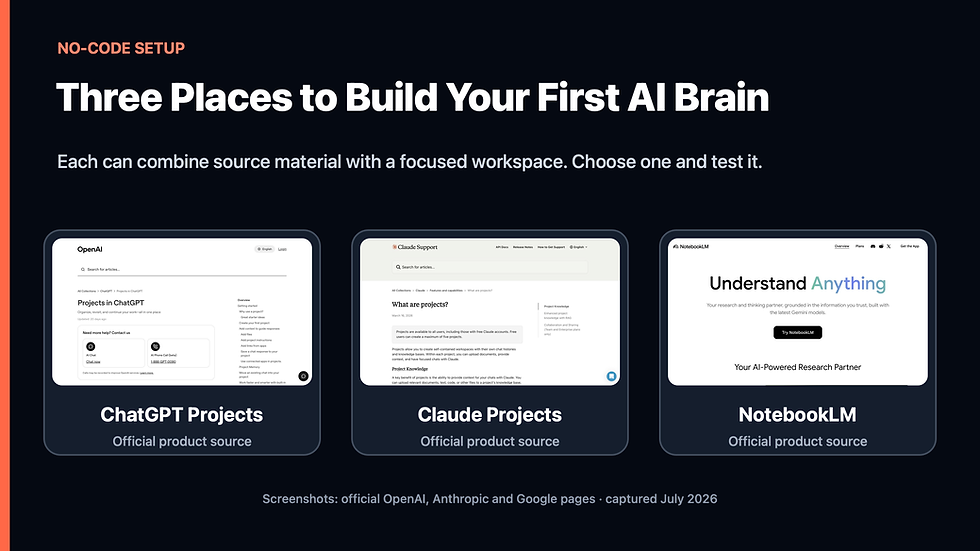
You can apply the BRAIN framework with tools that already support files, instructions and project context.
Option 1: ChatGPT Projects
OpenAI describes Projects as workspaces that keep chats, files and custom instructions together for repeated and evolving work. Project-only memory can also create a more contained context boundary for a new project.
Simple setup:
Create one project for one business function.
Add the five core files from your business library.
Add the permanent source and approval instruction.
Move only relevant conversations into the project.
Test it against known facts before using it for new work.
For longer assignments involving files and finished deliverables, ChatGPT Work can use project context and review criteria. Grant access only to the files needed for the task.
Option 2: Claude Projects
Anthropic’s Projects documentation says a project can contain its own chat history, knowledge base and instructions. That makes it a straightforward home for a focused business brain.
Use the same five-file test. The point is not to compare personalities between models. It is to see whether Claude can retrieve your evidence, apply your standards and identify uncertainty without being repeatedly corrected.
Option 3: NotebookLM
NotebookLM works well when the first job of your AI brain is research, synthesis or source-grounded Q&A. Google’s documentation says notebooks can use uploaded documents, Drive files, web pages, audio, PDFs, spreadsheets and other supported sources.
It is especially useful when you want the AI to stay close to a defined collection of material rather than improvise from general knowledge.
Which tool should you choose?
Choose the one that can answer “yes” to these questions:
Can it access the files you genuinely use?
Can it show where an important answer came from?
Can you keep different business contexts separated?
Can you update or remove outdated material easily?
Do its privacy and data controls fit the information involved?
The best tool is the one you will maintain. A sophisticated system that goes stale is less useful than a simple project you review every Friday.
How to Keep Your AI Brain Accurate and Safe

An AI brain can centralize value, which means it can also centralize risk. Treat it like a new employee with controlled access, not an all-seeing executive.
The NIST AI Risk Management Framework emphasizes ongoing risk management rather than a one-time safety check. For a small business, that principle can be translated into six practical rules.
1. Start with low-risk knowledge
Begin with marketing standards, public product information, approved examples and non-sensitive research. Do not make payroll data, customer identities, legal files or confidential contracts your first experiment.
2. Separate facts, opinions and instructions
Label source types clearly:
`FACT — Current pricing`
`EVIDENCE — Customer interviews`
`OPINION — Founder hypothesis`
`RULE — Claims requiring approval`
AI sounds confident even when categories blur. Labels make the boundaries easier to inspect.
3. Create a source hierarchy
Tell the system which file wins when information conflicts. A current pricing sheet should outrank a two-year-old proposal. A signed policy should outrank a brainstorming note.
4. Require citations for consequential claims
When the AI summarizes customer evidence, financial information, research or an approved promise, require the source name. Citations do not guarantee truth, but they make verification possible.
5. Keep external actions behind approval
Your AI brain may prepare an email, CRM update, campaign or recommendation. It should not automatically send, publish, purchase, delete or make high-consequence changes.
The safe rule from my AI-loop guide still applies: loop the repetition; keep the consequences human.
6. Keep a portable master copy
Do not let a platform’s internal memory become the only version of your business knowledge. Keep the master files in a location you control, with backups and clear ownership.
This is the same principle I return to in The Wolf Is at the Door: the opportunity is not surrendering more judgment to technology. It is using technology to make your judgment clearer, faster and harder to replace.
Your 30-Minute AI Brain Starter Plan

You do not need to digitize the entire company this weekend. Build one useful shelf.
Minutes 1–5: Choose one recurring outcome Pick content briefs, lead qualification, customer replies, weekly reporting or offer research.
Minutes 6–15: Gather five authoritative sources Choose the current offer, customer evidence, business rules, strong examples and current priorities.
Minutes 16–20: Write the operating instruction Define source priority, uncertainty rules, prohibited actions and the required output.
Minutes 21–25: Ask three known-answer questions Test whether the system can retrieve facts, distinguish rules and cite its sources.
Minutes 26–30: Give it one reversible assignment Ask for a brief, analysis, comparison or first draft. Review the work before anything leaves the project.
If it fails, do not compensate with a more elaborate prompt. Fix the missing knowledge, unclear rule or contradictory source.
That is the deeper lesson: an AI brain improves when you make your business easier to understand.
Frequently Asked Questions

What is an AI brain for business?
An AI brain for business is an organized system of company knowledge, examples, rules and decision history that AI can retrieve and apply to business tasks. It gives a general AI model context about how a specific business works.
Is an AI brain the same as training an AI model?
No. Most entrepreneurs do not need to train or fine-tune a model. They can use projects, knowledge bases, files and retrieval tools to supply business context to an existing model.
Is an AI brain the same as an AI agent?
No. An AI brain stores and organizes the context; an AI agent or workflow uses that context to complete work. Think of the brain as the company library and the agent as the worker consulting it.
What is the difference between an AI brain and a knowledge base?
A knowledge base stores information. An AI brain adds instructions, examples, source priorities and decision history so AI can apply that information to a task. A knowledge base is one component of the larger system.
Do I need to know how to code?
No. ChatGPT Projects, Claude Projects and NotebookLM can all support a useful first version through uploaded files and plain-language instructions. Coding becomes relevant when you need custom integrations, automatic syncing or advanced permissions.
How many documents should I add first?
Start with five to ten authoritative documents tied to one business outcome. Adding hundreds of files before testing retrieval usually creates more noise, duplication and conflict.
What files should I never upload?
Do not upload information that the platform, account or task is not authorized to process. Be especially cautious with customer identities, payment information, health records, passwords, confidential contracts, legal advice, employee files and unreleased intellectual property.
Can an AI brain stop hallucinations?
No. Better sources and retrieval can make answers more grounded, but AI can still misread, omit or invent information. Require source citations, test known answers and keep a human reviewer in front of consequential decisions.
How often should an AI brain be updated?
Update it whenever a material fact or decision changes, then schedule a brief monthly review. Fast-moving areas such as pricing, campaigns and active projects may need weekly maintenance.
Can I move my AI brain from ChatGPT to Claude or another tool?
Yes, if the authoritative knowledge is stored in portable files rather than only in platform memory or chat history. Some instructions and conversation context will need adaptation, but the core business library can move with you.
What is the best first use case?
Choose a repeated, low-risk task that depends heavily on business context and produces an output you can check. Content briefs, source-grounded research, customer-objection summaries and weekly decision reports are strong starting points.
How much does it cost?
The cost depends on the platform, subscription, file limits, model usage and whether you add automation or integrations. A basic version can often be tested inside an existing AI subscription; verify current plan limits before committing sensitive or operational work.
The entrepreneurs who stay ahead will not necessarily be those who collect the most AI tools. They will be the ones who turn what they know into context their tools can actually use.
A prompt borrows intelligence for a moment. An AI brain compounds your business intelligence over time.
Start with one outcome, five trusted sources and one clear set of rules. Build the smallest brain that can do useful work, then improve it every time the system exposes something your business has never made explicit.
If you want a structured path for turning this principle into practical business workflows, the 28-Day AI Mastery Challenge provides the implementation bridge.
---


Comments