_edited.png)
AI Agents for Entrepreneurs: 5 Workflows Your One-Person Business Should Automate First

Updated: Sep 4

If your one-person business still needs you to notice every lead, chase every reply, research every topic, and make every decision from scratch, you do not need another productivity hack. You need a different operating system. That is where AI agents for entrepreneurs are starting to matter. Not because they are replacing founders. Because they can finally take over the repeatable work that keeps dragging founders back into the machine.
The danger is that most entrepreneurs will use agents the same way they used chatbots: as shiny assistants for random tasks. They will ask for captions, summaries, and quick ideas while the real bottlenecks stay untouched.
That is how AI makes a business busier instead of freer.
In chapter 2 of The Wolf Is at The Door, I call this cruel optimism: the comforting belief that the next tool will save you while the system underneath stays broken. Agents can become cruel optimism with a dashboard if you point them at the wrong work.
What's in This Article
What AI agents for entrepreneurs actually are
Why agents are moving from novelty into real business workflows
The 5 workflows I would automate first in a one-person business
How to keep judgment human while letting agents do the prep work
Frequently asked questions about entrepreneur AI agents
What are AI agents for entrepreneurs?
AI agents for entrepreneurs are systems that can monitor a trigger, use connected tools, complete a repeatable process, and report back with the next best action. Unlike a one-off prompt, an agent is useful when the same business workflow keeps returning and the owner needs help with research, triage, follow-up, or decision preparation.
That definition matters because the agent market is shifting fast. OpenAI's workspace agents are designed for repeatable team workflows across connected apps. OpenAI gives the example of an agent pulling together call notes and account research, qualifying new leads, and drafting follow-up emails inside a rep's inbox.
Anthropic is aiming the same shift at smaller teams. Claude for Small Business connects Claude to tools small businesses already use, including QuickBooks, PayPal, HubSpot, Canva, DocuSign, Google Workspace, and Microsoft 365.
That is the signal. Agents are no longer just chat windows with confidence. They are being wired into the places where work actually happens.

The mistake: using agents like smarter interns
Most entrepreneurs will start by asking an agent to do whatever they already ask ChatGPT to do: write a post, summarize a PDF, draft an email, find a tool, make a plan.
Fine. Useful. But not transformative.
The leverage begins when the agent owns a repeated workflow with a clear trigger, a defined boundary, and an approval point. That could mean every new lead gets summarized, scored, and prepared for follow-up. Or every Friday, your agent reviews campaign results, flags what changed, and drafts the next test.
That is not replacing your judgment. That is protecting your attention from work that should have been prepared before it reached you.
What workflows should entrepreneurs automate with AI agents first?
Entrepreneurs should automate workflows that repeat often, create delay, and cost money when the owner misses them. The best first targets are lead triage, follow-up, research, reporting, and decision preparation because these workflows quietly control revenue, time, and execution speed.
Before you build or buy anything, score your recurring work against three questions:
Does this repeat every week?
Does it create delay when I ignore it?
Would faster preparation improve revenue, trust, or decision quality?
If the answer is yes to all three, you may have an agent-ready workflow. If the task is merely annoying, leave it alone for now.
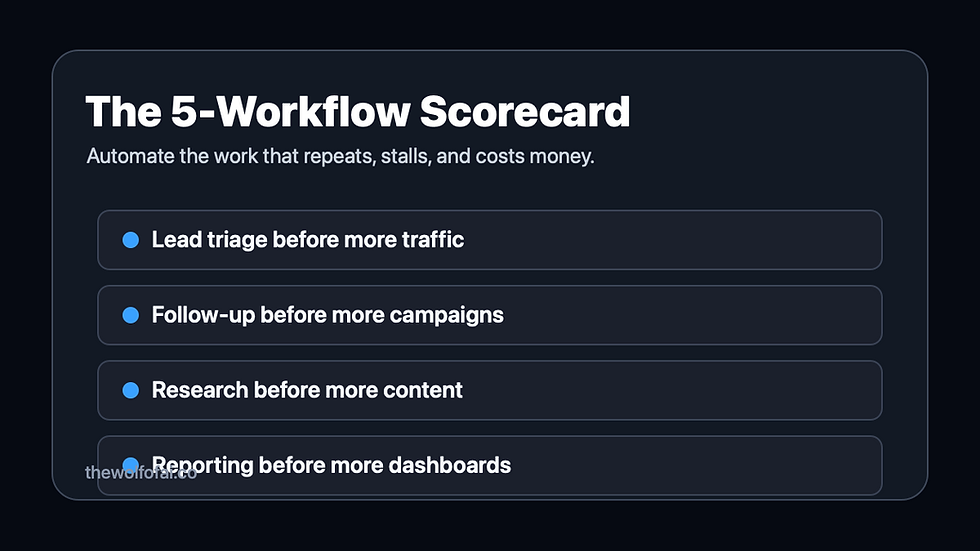
1. Lead triage before more traffic
The first workflow I would automate is not content. It is lead triage.
A lot of one-person businesses do not need more leads yet. They need fewer good leads going cold while the owner is buried in tabs. An agent can watch new replies, form submissions, booked calls, and download activity, then summarize intent, urgency, and next action.
That is why this belongs ahead of almost every AI productivity tips checklist. Saving five minutes on a caption does not matter if a hot lead waits five days for a reply.
2. Follow-up before more campaigns
The second workflow is follow-up. Boring, unsexy, and usually where the money is.
Your agent should not spam people. It should prepare the follow-up: what they asked, what they need, what objection is showing up, and which response options make sense. You approve the move. The agent removes the memory tax.
This is where AI workflow automation starts to feel like a business system instead of a prompt library.
3. Research before more content
Most content problems are research problems wearing a writing costume.
If an agent can monitor customer objections, competitor claims, search trends, tool launches, and support questions, your content gets sharper before you ever ask for a draft. The same research workflow can feed emails, videos, blog posts, sales pages, offers, and webinars.
That is the difference between another AI writing hack and AI tools for entrepreneurs that replace real workflows. The agent is not there to sound clever. It is there to see the pattern before your competitors do.
4. Reporting before more dashboards
Dashboards are where entrepreneurs go to pretend they have clarity. Reporting is what creates clarity.
An agent can review weekly metrics, explain what changed, compare performance against last week, flag anomalies, and draft the questions you should ask next. It does not need to make the decision. It needs to make the decision easier to see.
The U.S. Census Bureau reported in May 2026 that overall business AI usage hovered between 17% and 20% from December 2025 to May 2026. Usage was rising among firms with at least 20 employees, but not significantly changing among firms with fewer than 20 employees.
That gap should bother solopreneurs. Bigger firms are wiring AI into operating systems while smaller businesses are still experimenting with isolated tools.
5. Decision prep before decision-making
This is the workflow most entrepreneurs underestimate.
Do not ask an agent to decide for you. Ask it to prepare the decision. Compare options. Surface risks. Summarize evidence. List assumptions. Show what would make the decision wrong. Draft the plan. Then bring it to you.
That is a healthier relationship with AI. It makes you faster without making you passive.
In the book, I wrote that AI got an upgrade, which means we must, too. That is still the whole game. The founder who wins will not be the one with the most agents. It will be the one with the clearest judgment and the cleanest workflows.

How do you keep AI agents from creating chaos?
You keep AI agents from creating chaos by giving every agent a narrow job, clear tool access, approval rules, and a short reporting loop. The safest setup is not a digital employee with unlimited freedom. It is a workflow assistant that prepares work, explains the action, and waits for human approval when judgment or reputation is involved.
Turn those boundaries into a written assignment with the AI Delegation Contract, which specifies the result, authoritative context, permissions, quality checks and conditions that require the agent to stop.
Use this rule: the more public, financial, legal, or reputational the action is, the more human approval it needs.
That means an agent can monitor leads, draft responses, summarize data, and prepare recommendations. But sending sensitive emails, changing prices, publishing posts, or making customer promises should stay behind an approval gate.
The one-person business advantage
Here is the upside nobody talks about enough: one-person businesses can adopt this faster than big companies if they stay disciplined.
A corporation has committees, permissions, procurement, politics, and meetings about meetings. You have fewer layers. That is an advantage, but only if you avoid turning your business into a pile of half-connected automations.
Start with one workflow. Get it stable. Then add the next. If you want a deeper foundation for thinking through AI adoption, start with The Wolf Is at The Door and the bigger shift it maps out: the winners will not be the most optimistic. They will be the most adaptable.
Frequently Asked Questions About AI Agents for Entrepreneurs
What are entrepreneur AI agents?
Entrepreneur AI agents are repeatable workflow systems that can monitor triggers, use connected tools, prepare work, and report back with next actions. They are most useful when a business task repeats often and creates delay when the owner has to handle every step manually.
What is the best first AI agent for a solopreneur?
The best first AI agent for a solopreneur is usually a lead triage or follow-up agent because those workflows are directly tied to revenue. A content or research agent can also be valuable, but only if it feeds a clear business outcome instead of creating more drafts to review.
Can AI agents replace employees?
AI agents can replace pieces of a workflow, but they should not blindly replace human judgment. The strongest use case is preparing work, monitoring signals, and drafting options so the owner can make faster, better decisions.
What tools do AI agents connect to?
Modern AI agents can connect to business tools such as email, calendars, CRMs, documents, spreadsheets, design tools, payment systems, and accounting platforms. The specific tools depend on the agent platform and the permissions the owner or workspace admin allows.
How are AI agents different from prompts?
A prompt helps once. A workflow helps repeatedly. An agent can monitor a trigger, use tools, complete steps, and report back. That makes agents more useful for ongoing business operations than one-off content or brainstorming tasks.
Are AI agents safe for small businesses?
AI agents are safer when they have narrow scopes, limited tool access, approval gates, and clear reporting. Small businesses should avoid giving agents unrestricted authority over public, financial, legal, or customer-facing actions.
How do I learn AI agents without getting overwhelmed?
Start with one workflow instead of ten tools. If you want a structured path for using AI inside a business, the 28-Day AI Mastery Course gives you a practical way to build capability without getting lost in app-chasing.
Stop buying tools. Build leverage.
The next phase of AI will tempt entrepreneurs to collect agents the way they collected prompts, templates, and browser extensions.
Do not do that.
The opportunity is not to own the biggest stack. The opportunity is to build a business that no longer waits for you to remember, chase, research, summarize, and prepare every move yourself.
These agents should make the business less dependent on the owner's attention. Not because the owner no longer matters, but because the owner's judgment finally gets used where it belongs.
On the decisions. On the strategy. On the moves that compound.
Everything else should be prepared before it reaches you.


Comments