_edited.png)
AI Readiness Assessment for Small Business: A 12-Point Test Before Automation

Updated: Aug 25
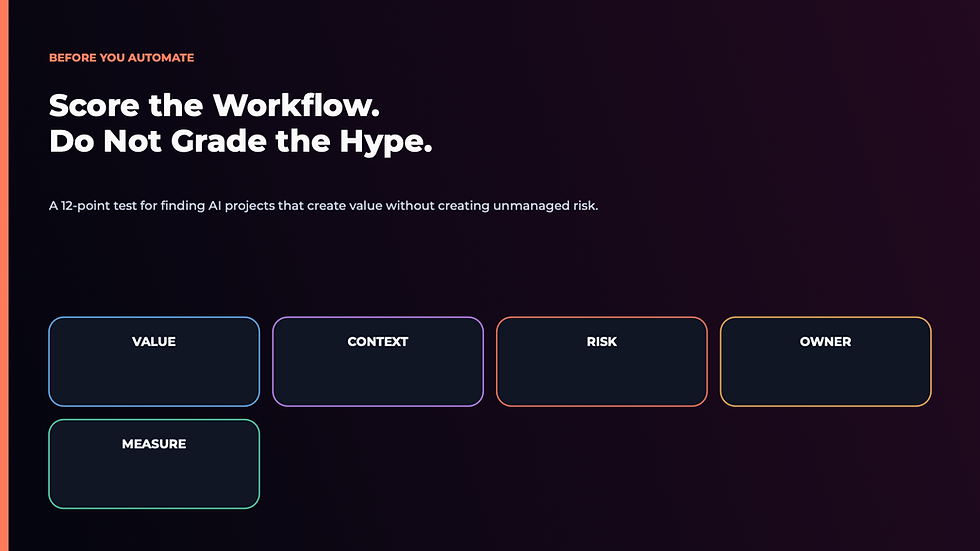
The demo looks perfect. An AI system reads the inbox, updates the customer record and drafts a reply before you finish your coffee. Then you try it with your own business and discover three versions of the price list, missing customer consent and no agreement about who approves a refund.
An AI readiness assessment for small business prevents that expensive sequence. It tests whether a specific workflow has enough value, reliable context, manageable risk and clear ownership to justify automation.
Quick answer: An AI readiness assessment for small business is a structured review of one proposed AI workflow before implementation. Score the workflow on business value, repetition, input quality, output standards, reviewability, privacy, consequence, ownership, reversibility, measurement, staff capability and maintenance. Automate only when the result supports a controlled, measurable pilot.
Readiness is not a personality trait and it is not a badge for the whole company. Your business may be ready to summarize customer feedback and completely unready to let AI issue refunds.
When several people need to build that readiness together, this AI training plan for small business teams provides a curriculum, budget and measured 30-day rollout.
In This Article
What Is an AI Readiness Assessment for Small Business?

An AI readiness assessment is a decision tool used before selecting or deploying an AI system. It asks whether the proposed use case is valuable enough, defined enough and controlled enough to test responsibly.
Think of it like a pre-flight check. The question is not whether the aircraft contains impressive technology. The question is whether this aircraft, crew, route, weather and safety plan are ready for this flight. A business can pass the check for one workflow and fail it for another.
This workflow-level view matters because AI adoption is uneven. Estimates from the U.S. Census Bureau’s 2026 Business Trends and Outlook Survey kept overall use in the high teens during the six months ending in early May. Its analysis of business AI use also found higher adoption among larger firms and reported that fewer than 20% of businesses with four or fewer employees were using AI.
That evidence does not mean small businesses should rush or wait. It means the market is still learning. A clear readiness test is more useful than copying a large-company implementation or assuming competitors have solved the problem.
The National Institute of Standards and Technology organizes voluntary AI risk management around four functions: govern, map, measure and manage. The NIST AI Risk Management Framework is broader than a small-business checklist, but the principle translates well: define the use and responsibilities, measure performance and risk, then manage the system throughout its life.
Ben’s doctrine: AI readiness belongs to the workflow with the evidence, not to the owner with the enthusiasm.
If you are still deciding what a complete workflow includes, read what AI workflows are before scoring the project.
The 12-Point AI Readiness Test

Score each item from 0 to 2:
0: missing or unknown;
1: partly defined or inconsistent;
2: clear, documented and testable.
1. Business value
Does the workflow affect time, revenue, customer experience, cost, risk or decision speed? “Use AI more” earns zero. “Reduce the two-hour weekly process for categorizing customer objections” can be measured.
2. Repetition
Does the work recur often enough to justify design and maintenance? A one-off task may be better handled with a supervised prompt than an automation.
3. Input quality
Are the source files accurate, current, permitted and easy to locate? AI cannot reliably resolve three conflicting price sheets unless the business first names the authoritative one.
This is where a structured AI brain for your business can improve readiness by organizing context and standards.
4. Output standard
Can you describe an acceptable result? Include required fields, tone, source rules, tolerances and prohibited actions. If two experienced people disagree about “done,” the AI will inherit the disagreement.
5. Reviewability
Can a qualified person check the output efficiently before consequences occur? A draft reply is reviewable. An autonomous decision buried inside thousands of transactions may require stronger monitoring and controls.
6. Privacy and permission
Does the workflow use personal, confidential, financial, legal or proprietary information? Do you have permission to process it with the selected service? Score zero when the answer is unknown.
7. Consequence
What happens when the system is wrong? A weak social caption and an incorrect tax instruction do not belong in the same risk tier.
NIST’s Generative AI Profile notes that generative AI can warrant different levels of human review, tracking, documentation and management oversight depending on use. A small business can apply that principle without building a compliance department: higher consequences require tighter access, stronger evidence and explicit approval.
8. Ownership
Who owns the workflow, reviews exceptions and decides when the system must stop? “The AI tool” is not an owner.
9. Reversibility
Can you undo the action, restore the previous state and recover the source record? Reversible work is a safer place to learn.
10. Measurement
What baseline and result will you compare? Measure complete workflow time, correction rate, customer outcome or another business metric—not the speed of the first generated response.
The site’s guide to using AI for business growth is useful here because it distinguishes low-value production from decisions that affect revenue and direction.
11. Human capability
Does someone understand the work well enough to brief, evaluate and improve the AI? A system cannot compensate for missing domain judgment by sounding confident.
The OECD’s latest skills brief, published in June 2026, identifies missing skills as a continuing barrier to adoption, particularly for small and medium-sized enterprises. Training belongs inside the readiness decision, not after launch.
12. Maintenance
Who will update instructions, sources, access and tests when the business or tool changes? An unattended workflow becomes less reliable as reality moves away from its assumptions.
How to Score the Result

Add the twelve scores for a maximum of 24, then apply a safety override.
0–11: Repair the process first
The workflow is not ready for automation. Clarify the source, standard, owner or business value. You can still use supervised AI for exploration, but do not connect consequential actions.
12–18: Run a controlled pilot
The workflow may be useful, but one or more conditions need testing. Keep the scope narrow, use safe inputs, require human approval and set a stop rule.
19–24: Ready to build and measure
The workflow has enough clarity for a structured pilot or build. A high score is permission to test—not proof that the selected tool will perform well.
The safety override
Do not proceed when privacy and permission, consequence, ownership or reversibility scores zero. A strong business opportunity does not cancel an undefined consequence.
This is the difference between a scorecard and a sales quiz. The objective is not to declare the business “AI ready.” It is to expose the missing condition while it is still cheap to fix.
For adjacent guidance on workflow selection, use the published small-business automation audit. That article helps identify bottlenecks; this assessment decides whether a specific candidate is ready for a controlled AI pilot.
From Readiness Score to a Safe First Pilot

Choose one workflow that scored at least 12 and has no safety override. Then run a seven-step pilot.
Write the baseline: Record current time, errors, delays and business outcome.
Freeze approved inputs: Name the files, fields or sources the AI may use.
Define done: Create an example and a short review rubric.
Limit access: Give the system the minimum information and permissions required.
Keep approval human: Let AI prepare; keep the consequential action behind a person.
Set a stop rule: Pause when error, risk, cost or uncertainty crosses a defined line.
Review weekly: Compare the result with the baseline and preserve corrections.
Suppose the workflow is weekly lead analysis. AI reads an approved, anonymized export; groups objections; links each conclusion to source rows; and drafts a report. A person checks the groupings before the report changes messaging or budget. The pilot measures hours removed and corrections required.
That is a better first project than “connect AI to the entire customer database.” It teaches the business how to control evidence, evaluation and handoffs.
The existing AI lead generation workflow offers a practical system in which a readiness-tested analysis step could live. The pilot should strengthen a real operating path rather than remain an isolated demonstration.
For business owners who want guided practice applying these decisions across real workflows, the 28-Day AI Mastery Course is the primary next step. The assessment tells you where to begin; the course supplies sequence, practice and standards for building the capability.
A Personal Note About Starting Before You Feel Ready

“Readiness” can sound like another gate you must pass before touching the technology. That is not the purpose of this assessment.
As an author and educator, I have spent much of my work helping people act under pressure without surrendering judgment, including in The Wolf Is at the Door. AI creates a new version of that challenge. Moving too slowly has a cost. Connecting a powerful system to a confused process has one too.
You do not need certainty to begin. You need a small enough experiment to learn without gambling the business.
Use the score to find the missing condition. Clean one source file. Define one approval. Choose one metric. Then run a reversible pilot and let evidence replace vague confidence.
If you want a month-long structure for doing that work across your business, continue with the 28-Day AI Mastery Course. The invitation is not to automate everything. It is to build the judgment required to choose and improve the right workflow.
Frequently Asked Questions

What does AI readiness mean for a small business?
AI readiness means a specific workflow has a valuable purpose, reliable inputs, clear output standards, manageable risk, a human owner and a way to measure results. It does not mean every part of the business is prepared for automation.
How long does an AI readiness assessment take?
A first-pass assessment of one familiar workflow can take 30 to 60 minutes. Research, privacy review or process cleanup may take longer. If the questions cannot be answered, that uncertainty is itself a useful result.
Who should complete the assessment?
The workflow owner should complete it with anyone responsible for data, customer impact, security, compliance or final approval. In a one-person business, the owner may hold all roles but should still examine each responsibility separately.
What is the best first AI workflow for a small business?
The best first workflow is repeated, time-consuming, low to moderate risk, easy to review and tied to a measurable result. Examples include summarizing anonymized customer feedback, preparing a weekly report or drafting content from approved sources.
Does a high readiness score guarantee success?
No. A high score indicates that the conditions for a controlled test are present. The selected tool may still perform poorly, cost too much or fail to improve the baseline. The pilot supplies the evidence needed for the final decision.


Trời dạo này nóng thất thường nên mình hay liếc nhanh nhiệt độ trước khi ra đường, và https://thoitiethomnay.org/ làm việc đó khá tiện. Vào cái là thấy ngay số hiện tại, lúc mình xem đang 30°C kèm “cảm giác như” cao hơn nên biết chuẩn bị tinh thần. Mình cũng thích kiểu chọn tỉnh/thành đặt rõ ràng, đổi qua chỗ mình cần coi chỉ mất vài giây. Trang cập nhật trong ngày nên quay lại sau vài tiếng là số liệu đã khác, đỡ phải đoán mò. Nhìn tổng thể không rối, các khối thông tin tách ra gọn nên mắt lướt một vòng là nắm được. Nói chung mình dùng như cái “check nhanh” mỗi sáng, vì ô…
keonhacai5 mình thấy bạn bè nhắc hoài nên cũng bấm vào coi thử cho biết, chủ yếu xem giao diện thôi chứ không ngồi đọc kỹ hay làm gì cả. Vào cái là thấy trang trình bày khá nhẹ mắt, khoảng trắng vừa đủ nên nhìn không bị bí. Mình thích kiểu họ chia nội dung thành từng khối rõ ràng, kéo xuống vẫn dễ theo dõi chứ không bị dồn chữ một cục. Có mấy phần dạng bảng ô thông tin nhìn gọn, liếc cái là nắm được ý chính. Thanh menu đặt ngay chỗ dễ thấy nên chuyển mục nhanh, không phải mò. Nói chung cảm giác như họ ưu tiên cho người mới vào xem nhanh, và…