_edited.png)
How to Use Perplexity for Marketing: 7 Research Workflows That Find Better Offers and Content


You open twelve tabs to understand a market. One tab says your buyer wants speed. Another says they want trust. A third insists price is the problem. Forty minutes later, you have more information and less confidence about what to publish, sell or change.
That is the real reason entrepreneurs search for how to use Perplexity for marketing. They do not need another place to ask clever questions. They need a faster way to turn scattered evidence into a decision they can defend.
Direct answer: Use Perplexity for marketing by giving it one commercial question, clear buyer and market boundaries, approved sources, and a defined output such as an offer brief, objection map or content gap report. Then verify the citations, compare the evidence with your own customer data and keep the final decision human.
Perplexity is an answer engine that searches the live web, synthesizes what it finds and places citations beside its claims. Its Research mode can investigate a deeper question across many sources, while Spaces can keep project instructions, threads and files together. That makes it useful for marketing research—but only if you stop treating the first polished answer as the finished strategy.
My rule is simple: AI research should reduce uncertainty before it increases output. If the research does not change a decision about your customer, offer, message or channel, it has probably created attractive noise.
This guide gives you seven practical workflows, a 45-minute research sprint and the approval boundaries that keep evidence from turning into confident fiction. If you want to turn research like this into a repeatable operating system, Ben Angel's 28-Day AI Mastery course helps you build the sequence, standards and human checks behind useful AI work.
In This Article
What Perplexity Marketing Research Actually Does

Perplexity marketing research combines live web search, source-linked synthesis and follow-up questions in one conversation. Instead of opening results one by one, you can ask it to investigate a market, compare claims and organize what it finds into a useful format.
Perplexity says every answer includes citations to original sources, which is the most important distinction for this job. A conventional chatbot can produce a smooth summary from its existing knowledge. Perplexity searches for current material and shows you where its claims came from. Perplexity's explanation of how its answer engine works also distinguishes quick answers, Pro Search and deeper Research mode.
Think of it as a research analyst working behind a glass wall. You can see the documents being passed across the desk. That transparency is useful, but it does not mean the analyst interpreted every document correctly—or selected the right evidence for your business.
For marketing, the strongest inputs usually come from five evidence buckets:
Buyer language: reviews, support questions, forum discussions and sales-call notes.
Competitor choices: pricing pages, positioning, guarantees, onboarding and public campaigns.
Market movement: first-party announcements, credible research and regulatory or platform changes.
Your own evidence: conversion data, email replies, customer interviews and lost-sale reasons.
Commercial constraints: your price, margin, delivery capacity, risk tolerance and timeline.
The public web can help with the first three. Your private business evidence controls the last two. Perplexity becomes much more useful when you deliberately separate them.
That is also why this article does not replace the broader ChatGPT, Claude, Perplexity and Gemini decision guide. That comparison helps you choose a tool. This guide gives Perplexity one narrower job: gather and challenge the evidence behind a marketing decision.
Why Most AI Research Produces Attractive Noise
The dangerous research failure is no longer an empty document. It is a polished report that looks finished before the thinking has started.
Ask, “What do small businesses want from AI?” and you may receive themes, statistics and citations. But the question has no country, business size, industry, price point, buying stage or decision attached to it. The output can be factually plausible and commercially useless.
The hidden mechanism is scope collapse. Several different markets are compressed into one generic buyer. Enterprise surveys sit beside consumer opinions. A loud Reddit complaint receives the same visual weight as a representative study. A competitor's homepage claim is treated like customer evidence. The answer becomes tidy because the important disagreements have been averaged away.
The usual response is to ask for more depth. That can create a longer version of the same problem.
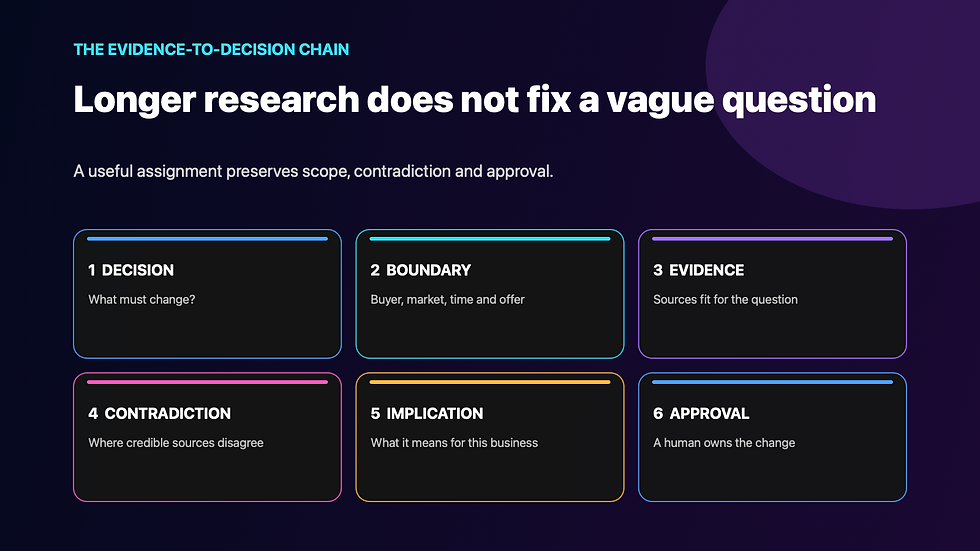
Instead, use what I call the Evidence-to-Decision Chain:
Decision: What must change after the research?
Boundary: Which buyer, market, time period and offer are in scope?
Evidence: Which sources can genuinely answer the question?
Contradiction: Where do credible sources disagree?
Implication: What does the evidence mean for this business?
Approval: Who decides what gets changed, sent or published?
This is the difference between “research our competitors” and “Compare the public pricing, guarantee and onboarding promises of these five competitors for US solopreneurs buying a $99–$299 AI course. Identify the repeated promise, the unresolved objection and one position we could credibly own. Cite every factual claim and label inference separately.”
The second assignment gives the research a destination. It also exposes where judgment is still required.
If your broader AI workflow keeps restarting from zero, building an AI brain for your business gives the research a stable layer of customer language, approved examples and operating rules.
How to Use Perplexity for Marketing: 7 Research Workflows

1. Find the language buyers use before they know your solution
Most marketing starts too close to the product. The business describes features while the buyer is still describing a frustrating Tuesday afternoon.
Ask Perplexity to gather recent language from product reviews, public forums, Q&A pages and credible articles around the problem. Give it a buyer boundary and require source links for every phrase cluster. Then sort the findings into moments, emotions, attempted fixes and desired outcomes.
Assignment: “For US solo consultants who struggle to publish consistently, find recurring public language from the last 12 months about the moment content creation breaks down. Separate direct quotations from your summaries. Return source, date, context and evidence limitation.”
The human approval boundary: never copy a person's vulnerable story into marketing without permission. Use public language to understand patterns, then write original copy.
The payoff is not a list of pain points. It is a more recognizable opening, email or landing page because you understand the moment before the buyer starts searching for a tool.
2. Build a competitor promise map
Competitor research often becomes a screenshot graveyard. The better question is not “What do they sell?” It is “Which promise is everyone making, and what important decision remains unresolved?”
Give Perplexity a fixed set of competitors and ask it to compare their current homepage promise, target buyer, price, proof, guarantee, objections addressed and call to action. Require current first-party pages rather than listicles about the brands.
Then add a contradiction column: where does the promise exceed the visible proof? That is an inference, not a fact, so label it clearly.
Ben doctrine: Do not differentiate by saying what competitors forgot. Differentiate by proving what buyers still doubt.
The output should help you choose one credible position—not inspire a collage of every attractive claim in the category.
3. Turn reviews into an objection ladder
Reviews reveal more than satisfaction. They show what buyers expected, what almost stopped them, what surprised them and what they still resent after paying.
Ask Perplexity to compare reviews across several relevant products, then group objections by buying stage:
“I do not understand this” — clarity objection.
“This is not for a business like mine” — fit objection.
“I can get this free” — value objection.
“I will not have time to use it” — implementation objection.
“I do not trust the result” — risk objection.
Require counts only when the source exposes a reliable total. A handful of visible reviews is anecdotal evidence, not a market percentage.
This workflow is particularly useful before writing a sales page or email sequence. If the implementation objection dominates, another feature paragraph will not help. The message needs to show the first small win and the time required to reach it.
4. Find content gaps that are commercial, not merely topical
A topic gap is something competitors have not covered. A commercial content gap is a buyer decision they have not resolved.
Ask Perplexity to inspect the top pages for your target theme and classify what each page actually helps the reader decide. Then identify unanswered comparison, cost, safety, implementation and right-fit questions.
The question is not, “Which keywords are missing?” It is, “Where does the reader still have to open another tab before acting?”
For example, dozens of pages can explain AI marketing prompts while few explain which business evidence should be loaded before the prompt is trusted. That is why my AI marketing prompts guide focuses on jobs and constraints rather than clever wording alone.
The human check is essential: confirm the gap against live search results and your current sitemap before assigning a new URL. If an existing page already owns the intent, refresh it instead of creating a sibling that competes with it.
5. Compare an offer against the market without copying it
Perplexity can help you stress-test an offer against visible alternatives. Give it your approved offer summary and ask for a comparison across buyer, promised outcome, time to value, delivery, risk reversal and price.
Then ask three questions:
Where is our offer harder to understand?
Where is our proof weaker than our promise?
Where can we make a more specific, credible commitment?
Do not ask AI to “make this better than every competitor.” That rewards louder language. Ask it to identify where the buyer must make an unsupported leap.
This is a diagnosis, not a permission slip to copy a competitor's structure or claims. The final offer still needs your evidence, delivery capacity and commercial judgment.
6. Build a source-backed campaign brief
Once the research is stable, Perplexity can turn it into a campaign brief. The brief should preserve the sources and disagreements rather than flattening them into one “insight.”
Request these sections:
buyer moment and consequence;
primary belief to change;
strongest supporting evidence;
objections and proof required;
message hierarchy;
claims that must not be made;
channel adaptations;
human approval checkpoints.
Perplexity advises users to state their intent, provide context and specify the desired format. Its official prompt guidance supports this assignment-style approach.
The practical payoff is consistency. Your email, reel, article and landing page can start from the same evidence without becoming identical copies.
7. Create a weekly market-change monitor
The final workflow is not another report. It is a short recurring question: what changed that might alter a current decision?
Track a bounded set of signals such as competitor pricing, a platform policy, a buyer objection, a category claim or a new source of proof. Ask for changed evidence only, with date and source, and require “no meaningful change” when that is the honest answer.
This is where the distinction between Perplexity Search and Perplexity Computer's action-oriented workflows matters. Search helps you understand the change. Computer may help execute a multi-step process. Keep monitoring read-only until a human approves the consequence.
If a competitor changes a price, that does not automatically mean yours should move. The alert creates a decision; it does not make one.
A 45-Minute Research Sprint You Can Run Today

Choose one live decision. Not “improve marketing.” Choose whether to change a headline, add a guarantee, create a comparison page or lead with a different objection.
Then run this sprint:
Minutes 0–5: Write the decision contract
Record the buyer, geography, time window, offer, evidence standard and final output. Finish the sentence: “At the end, I will decide whether to ___.”
Minutes 5–15: Run a broad evidence scan
Use Pro Search for a focused question or Research mode when the topic genuinely needs wider investigation. Perplexity says Research mode performs iterative searches, reads many sources and synthesizes a report; its Advanced Deep Research update also notes document analysis and broader source coverage.
Do not confuse volume with confidence. Record the most credible sources, the weakest source and one disagreement.
Minutes 15–25: Add your business evidence
Compare the public findings with sales-call notes, support emails, conversion data or customer interviews. This is where generic market advice becomes a business decision.
If you upload files, remove information the assignment does not need. Perplexity supports documents and other file types, but its file-upload guidance explains that long files may be reduced to the parts considered most relevant. Always return to the original document before making an important claim.
Minutes 25–35: Ask for contradictions and missing evidence
Prompt: “What credible evidence contradicts this recommendation? Which conclusion relies on inference? What would I need to verify before changing the offer?”
This step is where research earns its keep. A decision that survives a challenge is more useful than an answer that simply agrees with your first instinct.
Minutes 35–45: Make one micro-decision
Choose the smallest reversible change supported by the evidence. Rewrite one hero section. Add one objection-handling paragraph. Interview three customers before changing the price. Build one content brief instead of a 30-day calendar.
If you want to turn this sprint into a repeatable weekly system, Ben Angel's 28-Day AI Mastery course gives you a structured way to practice research, workflows, verification and human approval rather than collecting disconnected prompts.
What Perplexity Can Get Wrong

Perplexity can cite a real page and still draw the wrong implication from it. A source may be outdated, commercially biased, anecdotal, outside your target country or only loosely connected to the claim.
Treat every answer as a source map with a proposed interpretation—not as finished truth.
Use this verification ladder:
Open the citation and confirm it supports the exact sentence.
Check the publication date and whether the page has been updated.
Prefer first-party documentation for product capabilities and pricing.
Prefer original studies or datasets for research findings.
Separate a company's claim from independent evidence.
Mark forum posts and reviews as anecdotal.
Recalculate any number that changes the decision.
Perplexity recently added premium sources including PitchBook, CB Insights and Statista. Its official premium-source guide describes the available data providers and how they can be combined with web research. Paid access can improve source quality for some questions; it does not remove the need to understand the methodology or check whether the data fits your market.
The practical rule: a citation proves where a claim came from, not that the claim deserves your trust.
Protecting Client and Business Data

Marketing research becomes sensitive when you add customer lists, call transcripts, unpublished offers, campaign results or client documents.
Before uploading anything, classify it:
Public: already published and safe to share.
Internal: useful business context with no sensitive personal data.
Confidential: customer, client, financial, contractual or strategic information.
Restricted: credentials, regulated data, payment information or anything the tool should never receive.
Use only the minimum information required for the assignment. Anonymize names and identifiers. Do not upload a complete CRM export to answer a question that needs ten de-identified notes.
Perplexity says consumer search data may be used to improve its models unless the user opts out, while Enterprise data is not used for training. Perplexity's current data-collection explanation describes those plan-level differences and the opt-out control. These are vendor statements, not an independent security audit, and policies can change.
For a small business, the safe operating decision is straightforward: review the current settings and terms, limit the data, use enterprise controls when the risk justifies them and keep consequential actions behind a human approval gate.
That is the same principle behind a good AI workflow: AI prepares, compares and recommends; a named human approves the action that changes money, customers, public claims or access.
Before You Add Another Research Tool

If you are feeling relieved and slightly irritated after reading this, I understand. The appeal of Perplexity is that it can make a messy research job feel beautifully organized. The irritation is realizing that a polished answer does not remove the responsibility to decide what deserves belief.
Across eight books and years of publishing, I have learned that information is rarely the final constraint. The constraint is usually the standard used to turn information into a choice.
The entrepreneur who asks the sharpest question does not automatically win. The entrepreneur who installs the clearest evidence standard makes better decisions repeatedly.
That is why I care about this distinction. AI can shorten the distance between a question and a body of evidence. It can also shorten the distance between a weak assumption and a confident campaign. Your judgment is not the slow part to eliminate. It is the asset the workflow should protect.
My invitation is simple: choose one live marketing decision and run the 45-minute sprint. Keep the question narrow, open the citations and make one reversible change. If you want the structured practice to turn this into a repeatable business capability, use the 28-Day AI Mastery course as your next step.
I explore the wider strategic risk—what happens when intelligent systems influence more of our work, choices and identity—in The Wolf Is at the Door. Here, the immediate standard is smaller and more useful: do not let faster research outrun better judgment.
Frequently Asked Questions

Is Perplexity good for marketing research?
Yes. Perplexity is useful for finding current public sources, comparing claims and organizing research with citations. It is strongest when the user defines a commercial decision and verifies the original sources.
How do I use Perplexity for competitor research?
Give Perplexity a fixed competitor list, target buyer, geography, time window and comparison criteria. Ask it to use current first-party pages, cite every factual claim and label its inferences separately.
Is Perplexity better than ChatGPT for marketing?
Perplexity is often the better first tool when the job depends on current web research and visible citations. ChatGPT may be stronger for transforming approved research into drafts or working inside an established context. The right choice depends on the assignment, not the brand.
Can Perplexity create a marketing plan?
Yes, but the plan will only be as useful as the evidence, constraints and decisions you provide. Ask for a plan after validating the buyer, offer and channel assumptions—not before.
Is Perplexity free for marketing research?
Perplexity offers free search and limited access to advanced search features, while paid plans expand usage and access to additional capabilities. Check the current plan page before relying on a specific limit because product access changes.
Can I upload customer data to Perplexity?
You can upload supported files, but ability is not the same as permission. Remove personal or confidential information unless you have a lawful purpose, appropriate consent and a plan with controls that meet your obligations.
How do I know whether a Perplexity citation is reliable?
Open the source, confirm it supports the exact claim, check the date and methodology, and prefer first-party documentation or original research. Treat reviews and forum posts as anecdotal evidence.
What should I research first?
Research one decision with an immediate commercial consequence: the objection blocking a sale, the promise competitors cannot prove, the content question buyers still cannot answer or the assumption behind a planned campaign.


Comments