_edited.png)
ChatGPT vs Claude vs Perplexity vs Gemini: Which AI Tool Should Solopreneurs Use?

Updated: Aug 21

If you've ever opened ChatGPT, then switched to Claude for a second opinion, used Perplexity to verify the answer, and wondered whether Gemini would have done a better job in the first place, you're not alone.
Most solopreneurs aren't suffering from a lack of AI tools. They're suffering from too many options.
The problem is that ChatGPT, Claude, Perplexity Computer, and Gemini are often presented as direct competitors. They aren't.
Each was built with different strengths, different priorities, and different use cases in mind.
The tool that helps you brainstorm a new offer isn't necessarily the tool you should trust for live research. The tool that writes beautiful long-form content isn't always the one that helps you troubleshoot a technical problem, create a project, design an asset, or execute a task from start to finish.
After using all four extensively, one tool consistently stood out for a surprising reason: it reduced the amount of tool-hopping required to get real work done.
That doesn't automatically make it the winner.
The better question isn't "Which AI tool is best?"
It's "Which AI tool is best for the job you're trying to accomplish?"
In this guide, I'll break down where ChatGPT, Claude, Perplexity Computer, and Gemini each excel, where they fall short, and how solopreneurs can build a simple AI stack for leads, content, and sales without wasting money on tools they don't need.
You'll also see why relying on a single AI platform may be the biggest mistake entrepreneurs make as AI continues to evolve.
In this article
Where ChatGPT becomes an AI operating system for solopreneurs
Why Claude remains the strongest editor and strategic thinking partner
How Perplexity Computer combines research, execution, and 19 AI models in one workflow
When Gemini becomes the highest-leverage option inside the Google ecosystem
The beginner path: choosing one AI platform without overcomplicating your stack
The power-user path: assigning different jobs to different AI tools
The Wolf-at-the-Door warning: why depending on a single AI platform is the real risk
Where ChatGPT becomes an AI operating system for solopreneurs

ChatGPT is the most general-purpose tool of the four, which is both its strength and its weakness. If you need to dump a half-formed idea into a chat window and have something coherent come back, ChatGPT is faster than any other tool at that specific job.
For a solopreneur, ChatGPT earns its keep when you're at the front end of a project: sketching offers, generating angles for a sales page, drafting outlines, role-playing a sales call, or brainstorming 50 hook ideas before you pick three. It is the best thinking-out-loud partner because it rarely freezes up, rarely refuses, and tends to give you a usable first pass on almost anything you throw at it.
Where ChatGPT loses points is in the polish. The default voice is often generic, the kind of prose that screams AI wrote this. If you ship ChatGPT's first draft straight into an email or a landing page, you'll feel the engagement drop in your numbers. It's the tool you start with, not the tool you publish from.
Most people still think ChatGPT is just a chatbot.
What many solopreneurs don’t realize is that OpenAI now has its own AI-powered browser called ChatGPT Atlas.
Instead of constantly copying and pasting information between blog posts, email campaigns, spreadsheets, websites, and AI chats, Atlas lets ChatGPT work directly inside the browser while you browse. It can research competitors, analyze websites, compare products, summarize pages, and complete multi-step tasks without forcing you to jump between tabs all day.
In this video, I’ll show you how I used ChatGPT Atlas to eliminate more than 40 hours of work in a single month.
It's also the tool most aggressively being merged into a single super-app: chat, search, browsing, agents, code, and image all in one product. That's powerful, but it also means OpenAI now sits between you and an enormous chunk of your workflow. If you've never explored alternatives, you have a single-platform problem you haven't priced in yet. Switching from ChatGPT to Claude takes five minutes and is the easiest hedge most solopreneurs never bother to take. If you're brand new to ChatGPT itself, my ChatGPT explained for beginners post is the cleanest place to start.
Best ChatGPT jobs for a solopreneur
• First-draft outlines for blogs, emails, scripts, and offers
• Brainstorming 20 to 50 angles before you commit
• Deep Research reports with citations, competitor analysis, and market intelligence
• Role-playing sales calls, negotiations, and objection handling
• Atlas Browser workflows that research competitors, analyze websites, and complete multi-step tasks
• Building custom GPTs for recurring business processes
• Managing long-term projects with memory, files, and ongoing context
• Connecting information across documents, spreadsheets, and external tools
• Quick coding and automation help when you need to glue two tools together
• Generating images, visual concepts, and creative assets without leaving the platform
Where ChatGPT still trails Claude is in natural long-form writing and voice consistency. Out of the box, Claude often sounds more human and requires less editing. ChatGPT can close much of that gap, but it usually needs stronger prompting, examples, or a custom GPT to get there.
They are also about to release an 'all-in-one' solution that combines all of their ai tools into one model.
Why Claude remains the strongest editor and strategic thinking partner

If ChatGPT is the brainstormer, Claude is the editor.
For most copywriting, email sequences, sales pages, course scripts, and book chapters, Claude produces noticeably more natural, human-sounding prose at the same prompt quality. That's not a vibe. It's a pattern that shows up consistently in side-by-side tests.
Claude's newest models also tend to follow long, detailed instructions better than the others. If you've ever fed an AI a brand-voice guide, a 10-step prompt, or a large piece of source material and watched it forget half of it by paragraph three, Claude is the one that most often holds the line. For solopreneurs running saved prompts, brand-voice systems, or repeatable content workflows, that consistency is worth more than any benchmark score.
But Claude has quietly expanded beyond writing. Through Claude CoWork, Anthropic is increasingly positioning it as a collaborative AI teammate rather than just a chatbot. It's particularly strong at reviewing large documents, synthesizing research, refining ideas, and helping you work through complex projects that unfold over days or weeks rather than minutes.
If Claude becomes part of your writing and client workflow, the Claude watermark adds a new layer of disclosure and reputation risk to consider.
It's also surprisingly capable when it comes to structured design thinking. Whether you're mapping a course, planning a membership site, outlining an app, or creating a landing page wireframe, Claude tends to organize information in a way that feels clear, logical, and easy to execute.
The trade-off is that Claude is not trying to be an all-in-one operating system. Its ecosystem remains smaller than ChatGPT's, and it still isn't the first tool I'd reach for when I need live web research, browser automation, or a broad collection of specialized tools.
Claude also highlights why platform dependence is dangerous.
If your favorite model gets restricted, rate-limited, repriced, or region-blocked, your workflow can go dark overnight. That's not a Claude-only problem. It's a reminder that every AI subscription is rented leverage, not owned infrastructure.
Best Claude jobs for a solopreneur:
• Email newsletters and sales sequences
• Sales pages, opt-in pages, and long-form conversion copy
• Book chapters, course scripts, and editorial content
• Long, detailed prompts and brand-voice systems
• Reviewing, editing, and polishing AI-generated content from other models
• Analyzing large documents, reports, contracts, and research files
• Strategic planning, business thinking, and decision support
• Claude CoWork projects that require ongoing collaboration across multiple tasks
• Creating wireframes, layouts, app concepts, and structured design ideas
• Synthesizing large amounts of information into clear action plans
Where to not rely on Claude alone
• Real-time web research where current information is mission critical
• Fact-checking without independently verifying the original sources
• Competitive intelligence and market research that require extensive web crawling
• Browser-based workflows, automation, and agentic task execution
• High-volume brainstorming sessions where speed matters more than depth
• Teams that need a large ecosystem of connectors, custom tools, and third-party integrations
• Projects where you need multiple AI models working together rather than a single-model approach
How Perplexity Computer combines research, execution, and 19 AI models in one workflow
Most people use Perplexity like a search engine.
That's a mistake.
That matters.
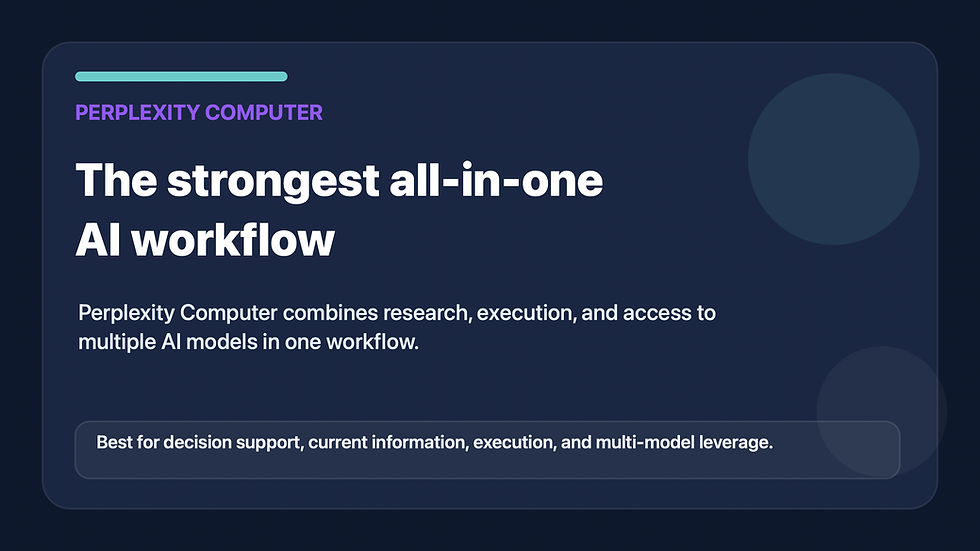
Instead of guessing whether ChatGPT, Claude, Gemini, Grok, or another model is best for the task, Perplexity can route your work across multiple models and give you one place to research, reason, compare, create, troubleshoot, verify, and act.
Most AI tools force you to choose a camp.
Perplexity Computer gives you the advantage of the whole field.
That is why I see it as the cleanest option for solopreneurs who want power without building a complicated AI stack.
For a solopreneur, the point isn't picking sides in the AI search war. The point is that research is no longer a job you do in a search engine and then a chatbot. It's one job, in one window, with cited sources. Perplexity Computer remains one of the cleanest, most accountable versions of that workflow for serious work, and the citation discipline forces you to think like an analyst instead of a copy-paster.
Best Perplexity jobs for a solopreneur:
1. Switch Between Multiple AI Models
Most users don't realize Perplexity lets you access multiple leading AI models from one interface. Instead of paying for several separate subscriptions, you can compare outputs and use the model best suited for the task.
2. Deep Research Reports
Ask Perplexity to investigate a topic, competitor, industry trend, or market opportunity and compile a detailed research report with sources attached.
3. Perplexity Computer
Instead of simply answering questions, Perplexity Computer can browse websites, compare information across multiple tabs, summarize findings, and complete multi-step workflows on your behalf.
4. Competitor Intelligence
Analyze competitor websites, offers, pricing pages, lead magnets, content strategies, and positioning without manually reviewing dozens of pages yourself.
To turn that research into better positioning and content decisions, use these Perplexity marketing workflows for offers, competitors and audience questions.
5. Collections
Create dedicated workspaces for different projects, clients, products, or business goals so your research stays organized and searchable.
6. File Analysis
Upload PDFs, reports, spreadsheets, contracts, presentations, or transcripts and ask questions directly against the contents.
7. Source Verification (Critical)
Unlike most AI tools, Perplexity shows the sources behind its answers, making it far easier to verify facts before publishing content or making decisions.
8. Follow-Up Research Chains
Instead of starting over with every query, you can continue asking deeper questions within the same conversation, allowing research to compound naturally.
9. Market Monitoring
Track emerging trends, industry news, competitor moves, funding announcements, pricing changes, and customer conversations without spending hours searching manually.
10. Skills for Repeatable Workflows
One of Perplexity's most underrated features is Skills. Think of them as reusable AI workflows that package your instructions, prompts, and processes into a repeatable system.
For example, you could create a skill that:
Reviews a competitor's website and summarizes their offer
Generates a weekly AI news briefing
Analyzes a YouTube transcript and extracts content ideas
Creates a pre-call research report on a prospect
Audits a landing page and identifies conversion opportunities
BONUS FEATURE: Problem Solving and Self-Recovery (Most Underrated Feature)
This is one of the most overlooked advantages of Perplexity Computer.
Most AI tools fail in a predictable way. They hit a roadblock, throw an error, tell you something went wrong, and hand the problem back to you.
Perplexity Computer is different.
When it encounters obstacles during a workflow, it will often try alternative approaches, launch additional processes, or explore different paths to complete the task instead of immediately giving up and waiting for your next prompt.
For solopreneurs, this can be a massive time saver.
Imagine you're trying to:
• Connect your blog to an automation platform
• Troubleshoot an AI workflow that suddenly stopped working
• Analyze social media performance across multiple platforms
• Fix an email integration that broke overnight
• Diagnose why a website, plugin, or API connection has failed
Instead of becoming the bottleneck, Perplexity frequently continues investigating the problem and working toward a solution.
The result is less time acting as your own IT department and more time focused on growing the business.
This may sound like a small feature, but for many solopreneurs it's the difference between an AI assistant that answers questions and one that actively helps solve problems.
If you want a broader map of the solopreneur AI stack beyond these four, my round-up of the top AI tools for entrepreneurs is a good companion read.
When Gemini becomes the highest-leverage option inside the Google ecosystem
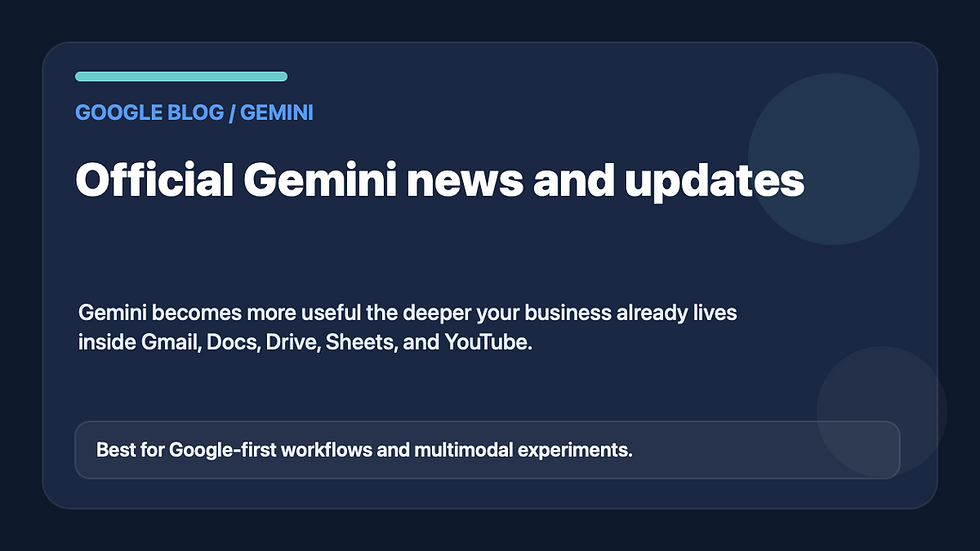
Gemini is the tool that punishes you hardest if you ignore it and rewards you hardest if you use it where it actually shines.
For a solopreneur, Gemini's real edge isn't the chat window. It's the integration. Gemini lives inside Gmail, Google Drive, Google Docs, Google Sheets, YouTube, Google Search, and more. If 80 percent of your business runs through Google's products, ignoring Gemini is leaving leverage on the table.
It's also one of the best options for fast experiments with text, image, audio, and video in one place, and Google AI Studio gives you the full Gemini playground for free, which is genuinely one of the most underused assets on this list for marketers.
But this matters: Gemini is also the tool that can change plan tiers, product packaging, and usage economics quickly. If you migrate your entire workflow into Gemini today, you still need a backup plan for what happens when the rules move. That is not a minor footnote. That is the wolf at the door.
Best Gemini jobs for a solopreneur:
Anything inside Google Workspace: Docs, Sheets, Gmail, and Drive
YouTube research, transcript work, and Shorts ideation
Quick experiments with text, image, audio, and video in one place
Quick local-business and competitive research via Google's ecosystem
Free prototyping inside Google AI Studio
Where to not rely on Gemini alone
Long-form brand-voice copy
Final fact-checked research
Anything mission-critical where price or feature stability matters in the next 90 days
If you want more on the foundational tool set behind this, AI Marketing 101 and my AI for Beginners list of 17 real-world tools will fill in the gaps without dragging you into agent-hype territory.
The beginner path: choosing one AI platform without overcomplicating your stack
Most solopreneurs do not need four AI tools.
In fact, if you're just getting started, there's a strong argument for using a single platform before building a more advanced stack. The temptation is to subscribe to every new AI tool that launches, but that often creates more complexity than leverage. Before long, you're paying for multiple subscriptions, jumping between tabs, and spending more time managing your tools than using them.
That's why I believe Perplexity Computer is currently the strongest all-in-one option for most entrepreneurs.
What makes it different isn't that it has the best model. It's that it doesn't force you to bet on a single model in the first place. By leveraging 19 different AI models inside one workflow, Perplexity gives you access to a broad range of capabilities without forcing you to constantly decide whether ChatGPT, Claude, Gemini, or another model would be better suited for the task.
For many solopreneurs, that's enough.
If you're writing a blog post, for example, Perplexity can research the topic, identify supporting statistics, analyze competitor content, uncover emerging trends, generate content ideas, create an outline, draft the article, help troubleshoot publishing issues, and even assist with distribution. The same principle applies to sales research, market analysis, competitor intelligence, customer discovery, and countless other business tasks.
That's why I recommend Perplexity Computer as the starting point for most people.
It reduces the amount of tool-hopping required to get meaningful work done, which is often the biggest productivity killer in the first place.
However, there comes a point where specialization begins to outperform convenience.
As your business grows, you'll start noticing that different platforms excel at different parts of the workflow. Perplexity may be exceptional at research and decision intelligence, but ChatGPT often generates a greater volume of ideas. Claude frequently produces stronger final copy with less editing. Gemini becomes increasingly valuable once your business is deeply embedded inside Google's ecosystem.
That's where the power-user path begins.
Rather than asking one AI platform to do everything, you start assigning specific jobs to the tools that perform them best.
• Perplexity finds the opportunity.
• ChatGPT explores the possibilities.
• Claude refines the message.
• Gemini helps run the operation.
At that stage, you're no longer choosing between AI tools. You're building a system.
Research flows into ideation. Ideation flows into execution. Execution flows into operations. Each platform contributes its strengths while compensating for the weaknesses of the others.
More importantly, you're reducing your dependence on any single company, model, or platform. If one provider changes its pricing, limits access, removes a feature, or falls behind the competition, your entire workflow doesn't collapse overnight because you've built flexibility into the system.
That's the real lesson.
The goal isn't finding one AI tool to rule them all. The goal is understanding which tool owns which job, then building a workflow that allows each platform to contribute where it creates the most value.
The wolf-at-the-door warning: never depend on a single AI tool

By now, you've probably noticed something important.
None of the tools in this article won every category.
ChatGPT wasn't the best writer. Claude wasn't the best researcher. Perplexity wasn't the strongest ecosystem. Gemini wasn't the most versatile standalone assistant.
Each platform excelled in certain areas and fell short in others.
That isn't a weakness of the current AI landscape. It's the reality of it.
Yet most entrepreneurs continue asking the wrong question. They ask, "Which AI tool should I use?" as though there is a single winner that will solve every problem in their business.
There isn't.
In fact, the biggest risk facing solopreneurs in 2026 isn't choosing the wrong AI tool. It's choosing the right one and becoming dependent on it.
Because you don't own the platform.
You don't control the pricing, the roadmap, the models, the integrations, the usage limits, or the business decisions being made behind closed doors. Every one of these companies is racing to become the operating system for your business, and every one of them can change direction faster than most entrepreneurs can adapt.
That's why I believe the most important lesson from this comparison has very little to do with ChatGPT, Claude, Perplexity, or Gemini themselves.
The lesson is that AI should be treated as leverage, not infrastructure.
The assets that matter most in your business remain the same assets that mattered before AI arrived: your audience, your customer relationships, your email list, your intellectual property, your reputation, your expertise, and your ability to solve meaningful problems for real people. Those are assets you own. AI platforms are tools that help you amplify them.
The entrepreneurs who thrive over the next decade will be the ones who understand the difference.
They will use AI aggressively, automate what can be automated, and move faster than their competitors. At the same time, they will continue investing in assets that remain valuable regardless of which model happens to be winning the benchmark wars this quarter.
The second lesson is flexibility.
One of the reasons I like Perplexity's multi-model approach is that it quietly acknowledges a reality most people ignore: today's winner may not be tomorrow's winner. The AI industry is moving too quickly to make long-term bets on a single platform. The model that dominates this year may be overtaken next year. Features will be added. Features will disappear. Pricing will change. Entire categories of products will emerge that don't exist today.
The solopreneurs who adapt fastest won't necessarily be the ones using the most advanced AI tools. They'll be the ones who remain flexible enough to take advantage of whatever comes next.
Finally, there is the question of human judgment.
As AI becomes increasingly capable, the value of generating information continues to fall. What becomes more valuable is knowing what to do with that information. AI can produce ideas, summarize reports, write drafts, analyze competitors, and even execute increasingly complex tasks. What it still cannot replicate is your experience, your instincts, your understanding of your customers, and your ability to recognize which opportunities are worth pursuing in the first place.
That is why I believe the future belongs to entrepreneurs who combine AI leverage with strong human judgment rather than entrepreneurs who attempt to replace judgment altogether.
So if you're looking for a simple answer to the question posed at the beginning of this article, here it is.
Use Perplexity Computer if you want the strongest all-in-one solution.
Use ChatGPT when you need ideas, exploration, and flexibility.
Use Claude when the quality of the final communication matters.
Use Gemini when your business lives inside Google's ecosystem.
More importantly, understand why each tool excels where it does.
Because the goal was never finding one AI tool to rule them all.
The goal is building a business that can benefit from AI without becoming dependent on any single platform.
The Quick Verdict

If you've skipped to the end looking for the answer, here it is.
For most solopreneurs, Perplexity Computer is the strongest all-in-one option because it combines research, execution, source verification, troubleshooting, and access to 19 AI models inside a single workflow.
If your primary focus is content creation, Claude remains the strongest choice for final drafts, long-form writing, and brand voice consistency.
If you need an AI operating system that can brainstorm, research, build workflows, create custom GPTs, and support a wide range of business activities, ChatGPT remains difficult to beat.
If your business runs heavily on Gmail, Docs, Sheets, Drive, Search, and YouTube, Gemini can create leverage that the other platforms simply cannot match.
Then answer the promise:
Best AI Tool by Business Function
Leads: Perplexity Computer
Because finding opportunities, researching prospects, analyzing competitors, and monitoring markets are fundamentally research problems.
Content: Claude
Because quality beats quantity once something reaches a customer.
Sales: ChatGPT
Because brainstorming offers, handling objections, roleplaying conversations, and generating multiple angles are where ChatGPT excels.
Operations: Gemini
Because it's embedded directly into the Google tools many businesses already use every day.
Your next move starts here
If you only do one thing after reading this, pick the single tool you are most dependent on right now and spend 30 minutes inside the one you've been ignoring. If it's ChatGPT, go try Claude. If it's Claude, go run a real research query in Perplexity. If you live in Google Workspace, go open Gemini and ask it to summarize the last 10 emails from your top customer.
The point is not to switch. The point is to stop being a tenant.
If you want the full system, how to build a one-person business that survives the giants instead of getting absorbed by them, that's exactly what I built The Wolf of AI book and the 28-Day AI Mastery Course to do. The book gives you the worldview. The course gives you the system, the prompts, and the weekly execution plan.
The wolf is already at the door. The question is whether you're irreplaceable by the time it comes through.


Comments