_edited.png)
OpenAI Just Killed the AI Tool Stack — Here's What Solopreneurs Should Do Before June Ends


For three years you've been told to build a "stack." A tool for writing. A tool for code. A tool for browsing. Something to glue them together. OpenAI just announced it's collapsing all of that into one app — and if your business is wired into the old way of doing things, the next few weeks are going to feel like the floor shifting under your feet.
This isn't a feature update. It's a redrawing of where you sit relative to the most powerful company in AI. Let me show you exactly what's happening, why it hits a one-person business harder than anyone, and the precise move I'm making before June ends.
TL;DR — Key Takeaways
OpenAI is merging ChatGPT, Codex, and its Atlas browser into a single agentic "super app," reportedly weeks from release.
Co-founder Greg Brockman now leads all product strategy, with OpenAI saying it will merge ChatGPT and Codex into one unified agentic experience (TechCrunch).
On June 2, 2026, Codex became a full workspace builder and crossed 5 million weekly users, with non-developers growing 3x faster than developers (Windows Forum).
The real risk for solopreneurs is vendor lock-in — convenience now, lost leverage later.
The durable move: own the skill of directing AI, stay tool-portable, and adopt the leverage without surrendering to a single platform.
What Is OpenAI's Super App?
OpenAI's super app is a single desktop application that merges ChatGPT (conversation), the Codex agent (code and task execution), and the Atlas browser (AI-native web research) into one agentic interface. It lets a user research, build, and execute multi-step tasks in one session instead of switching between separate tools — behaving less like a chatbot and more like an operating layer between you and every app you use (Zen van Riel).
Here's the plain-English version: instead of you bouncing between five tabs, one app does the bouncing for you. You ask it something, it browses, writes the code, drafts the doc, and hands you the finished result. The components map out like this:
Component | What it does | Why it matters for the merger |
ChatGPT (GPT-5.5) | Conversational AI with better memory and task continuity | The front door — where you talk to the system |
Codex Agent | Code generation, app/site building, task execution, automation | Now a full workspace builder, not just a coding tool |
Atlas Browser | AI-native web research with native context sharing | Brings live web data into the same session |
Unified Desktop App | One interface, cross-tool state management | Removes tool-switching — and centralizes your workflow inside one vendor |

That last row is the whole story. Convenience on the surface; consolidation underneath. If you're newer to all this and want the ground floor first, here's the plain-English breakdown of chatgpt smart and simple ai — start there before anything advanced.
What Did OpenAI Actually Announce?
In May 2026, OpenAI reorganized its entire product org to merge ChatGPT, Codex, and the Atlas browser into one unified agentic app, and placed co-founder Greg Brockman permanently in charge of product strategy. The company said it would "invest in a single agentic platform and merge ChatGPT and Codex into one unified agentic experience for all" (TechCrunch).
That's the corporate language. Watch what they actually shipped, because it moves fast. The reorg was framed as a way to "execute with maximum focus toward the agentic future" across consumer and enterprise (Tech Times). Brockman has described GPT-5.5 as pushing AI toward "agentic" systems that can complete tasks, not just respond (Ed Sim, LinkedIn).
Then it got concrete. On June 2, 2026, OpenAI turned Codex from a coding assistant into a full workspace builder — adding Sites (host and share interactive apps from a prompt), role-specific plugins that reach into CRMs, spreadsheets, data warehouses and messaging tools, and annotation editing that lets you change one section of a doc or site without regenerating the whole thing (Windows Forum).
And the adoption numbers are real. As of June 2, 2026, Codex had crossed 5 million weekly active users, with non-developers — knowledge workers like you and me — now roughly one-fifth of the base and growing more than three times faster than developers (Windows Forum). The desktop super app tying it all together is reportedly weeks from release (reported via Instagram). For scale: ChatGPT's mobile app passed one billion monthly users in May 2026 (Reuters via Ecorpit). One company. One app. A billion people. Coming for the work you currently spread across five tabs.

In The Wolf Is at the Door, the rule is blunt: in the age of disruption, the only durable advantage is being irreplaceable — and you can't be irreplaceable if you've handed your whole operation to a platform that can change the terms whenever it likes.
Why Does This Hit Solopreneurs Harder Than Big Companies?
A super app hits solopreneurs harder because they have no IT team to manage tool transitions and no leverage to negotiate terms. When one vendor owns your conversation, your code, your browsing, and your data, that vendor controls your pricing, features, and ability to leave — while a large enterprise can spread risk across multiple vendors and contracts.
A 200-person company has an IT department to absorb a migration. You are the IT department. You're also the marketing team, the operations lead, and the person who has to keep revenue flowing while the ground shifts. The stakes aren't abstract — they're your entire operating system.
Is the OpenAI Super App a Vendor Lock-In Risk?
Yes — the OpenAI super app carries real vendor lock-in risk. Building your daily workflow around a single all-in-one platform makes switching to a competitor far harder later, because your processes, data, and habits become tied to one vendor's ecosystem. The convenience is real, but so is the loss of flexibility and negotiating leverage over time.
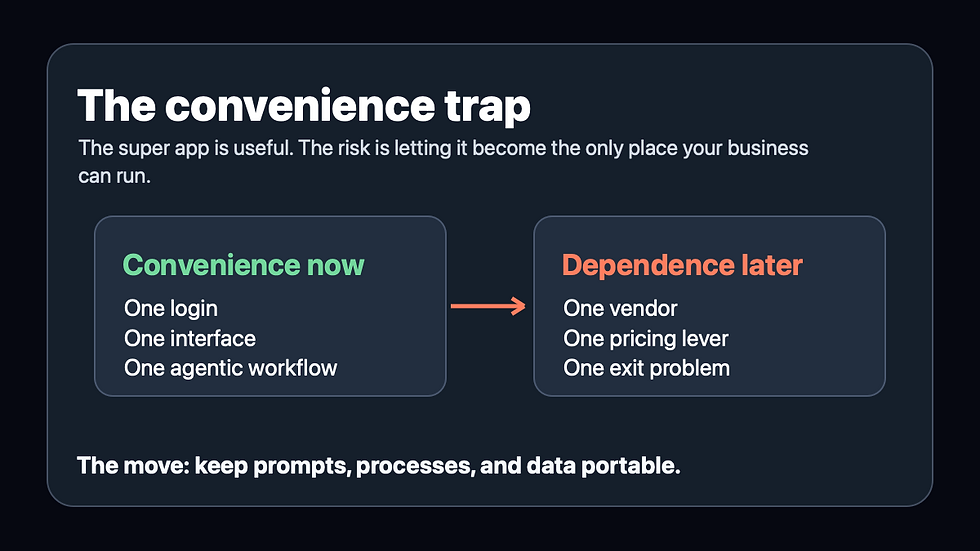
One analysis of the merger warned that once a business has built its day-to-day around the super app, moving to an alternative later becomes painfully hard (loaded.ch). Even enterprise investors are openly weighing AI adoption speed against lock-in risk (Ed Sim, LinkedIn).
This is the wolf at the door. Not the dramatic, robots-take-your-job version. The quiet version — where a platform slides in between you and your own business, and you don't notice until the day a price changes or a feature you depended on disappears.
The Mistake Most People Will Make
They'll do one of two things, and both are wrong.
The first group will panic-rebuild everything inside OpenAI's super app the moment it ships, because it's easier. Six months later they're fully dependent on one vendor with zero leverage.
The second group will ignore it, keep duct-taping their old stack together, and wake up one morning to find a workflow quietly broke because a tool they relied on got absorbed or deprecated.
The move isn't "pick the right tool." Tools are going to keep merging, dying, and price-hiking — that's the permanent condition now, not a one-time event. The move is to stop being defined by your tools at all.
What Should Solopreneurs Do Before June Ends?
Before June ends, solopreneurs should do three things: master the transferable skill of directing AI (which survives any tool change), stay tool-portable by keeping prompts, processes and data in formats they control, and adopt the super app's leverage without making it the only place their business can run. The skill is the asset; the tool is just the current container.
Here's my exact play. None of it depends on which app wins.
1. Own the skill, not the software
The thing that survives every merger is your ability to direct AI — knowing what to ask, what good output looks like, and how to fix bad output. The interface will change ten times; the skill of directing it won't. If you don't yet have a rock-solid grip on the fundamentals, the plain-English breakdown of chatgpt smart and simple ai is the foundation I send people to first.
2. Stay tool-portable on purpose
Keep your prompts, processes, and data in formats you control — not locked inside one app's proprietary walls. And practice leaving. I wrote a guide on how to switch from ChatGPT to Claude in five minutes for exactly this reason. The moment you know you can leave, the platform loses its grip on you. (Plenty of teams already keep a cheaper open-source fallback in their back pocket for when pricing climbs — optionality is leverage.)
3. Use the super app's power without surrendering to it
Agentic tools are extraordinary leverage for a one-person business — that part is genuinely real. If you want to see what's actually possible, look at these ChatGPT Atlas agent workflows for solopreneurs. Adopt the leverage. Just don't let it become the only place your business can run.
The Rule That Survives Every Disruption

Tools are leverage. They are never the foundation. The foundation is the skill, the relationships, and the judgment that no merger can absorb. If you want the full framework for staying irreplaceable while the giants consolidate, that's what The Wolf Is at the Door is built around.
The super app is coming in weeks, not years. You don't have to fear it — but you can't afford to sleepwalk into depending on it either.
Build the Skill That Makes You Tool-Proof
If you want a structured way to build the skill that makes you tool-proof, my 28-Day AI Mastery Course walks you through exactly how to direct AI like a pro, so it never matters which app wins the war. Start before June ends — because OpenAI already did.
Frequently Asked Questions About the OpenAI Super App

What is the OpenAI super app?
The OpenAI super app is a single desktop application merging ChatGPT, the Codex agent, and the Atlas browser into one agentic interface, letting users research, build, and execute multi-step tasks without switching tools. It is reportedly weeks from release as of June 2026 (reported via Instagram).
When is the OpenAI super app launching?
OpenAI has not announced a firm public launch date. As of June 3, 2026, reporting indicated the super app would be released in the upcoming weeks, with Codex's workspace expansion already live as of June 2, 2026 (Windows Forum).
Does merging ChatGPT, Codex, and Atlas create vendor lock-in?
Yes. Consolidating conversation, code, and browsing into one vendor's app makes a business's workflow harder to move elsewhere over time, reducing flexibility and negotiating leverage even as it adds convenience (loaded.ch).
How should a solopreneur prepare for the AI super app?
A solopreneur should prioritize the transferable skill of directing AI, keep prompts and data in portable formats, maintain at least one alternative platform, and adopt agentic tools for leverage without making any single app the only place their business can operate. For the fundamentals, start with this guide to chatgpt smart and simple ai.
Is the OpenAI super app the same as GPT-5.5?
No. GPT-5.5 is the underlying model that powers the conversational layer; the super app is the unified desktop application that combines that model with Codex and the Atlas browser into one agentic workspace (Zen van Riel).


The warning about collapsing your writing, coding, browsing, and automation tools into one agentic workspace is timely—solopreneurs need a backup plan before June ends. I've been using https://pixal3d.info/pixal3d-for-comfyui
The warning about wiring your whole business to one agentic workspace is timely—consolidation brings speed, but also a serious single-point-of-failure risk. I’ve been using https://ltxai.pro
The shift from a multi-tool stack to one agentic workspace could be huge, but the warning about platform dependency matters just as much. I’m reviewing my backup workflows now—check out https://klingapi.site/compare/kling-vs-pika
The shift from a multi-tool stack to one agentic workspace is exciting, but the dependency risk deserves equal attention—especially for solopreneurs. I’ve been testing a simple fallback workflow with https://pikaai.pro