_edited.png)
AI Business Disruption: The $14 Billion Warning—Your Clients Are Cutting Costs Too


You upload three months of customer data into an AI tool. Twenty minutes later, it produces the analysis that once required a consultant, a junior team member and a $5,000 invoice.
You feel efficient. Maybe even a little smug. That is AI business disruption in miniature: the same tool reducing your cost can make your client question yours.
Then your best client opens the same tool and asks it to produce the work they currently buy from you.
That is the part of learning how to future-proof your business from AI that most entrepreneurs are avoiding. Just as you are using AI to reduce costs, so are your clients—and the next expense they remove could be you.
This is no longer a theoretical warning. An April 2026 Entrepreneur story described education company Chegg as a $14 billion business “wiped out” by AI after students gained instant access to tools such as ChatGPT and Claude. The headline is dramatic, and not literally accurate: Chegg still operates. But its decline is real enough to make every service provider, educator, consultant and content business uncomfortable.
At its February 2021 peak, Chegg was valued at approximately $14.7 billion. By the fourth quarter of 2025, Chegg reported revenue had fallen 49% year over year, and the company recorded a $32.8 million quarterly net loss. Its legacy academic-services business was shrinking while management attempted to reinvent the company around professional skills.
Chegg did not suddenly forget how to answer homework questions. Its customers discovered that the answer itself was no longer scarce.
Quick answer: To future-proof your business from AI, identify which parts customers can reproduce cheaply, then move your value toward judgment, proprietary knowledge, accountability, relationships, implementation and a recognizable personal brand. Use AI to remove commodity work inside the business, but reinvest the savings in the reasons a customer would still choose you.
If you are already working through the 28-Day AI Mastery Course, this is the commercial question underneath every automation you build: does this system merely lower your costs, or does it make your business more difficult for a client to replace?
In This Article
What Chegg Teaches Us About AI Business Disruption

For years, Chegg gave students convenient access to textbook solutions, homework support and expert answers through a paid subscription. It owned a recognizable brand, a large content library and the distribution required to place that material in front of students.
Then generative AI changed the customer’s available alternative.
A student who once had to visit Chegg, search its library and pay a monthly fee could ask a conversational AI tool for an explanation immediately. The new option was cheaper, broader and easier to access. Chegg responded with its own AI product, but adding AI to the existing offer did not restore the scarcity on which that offer had depended.
The original Entrepreneur story compresses this into a clean cautionary tale: a $14 billion company was wiped out. The company’s own filings show a messier and more useful truth. Chegg’s 2025 annual report says academic-services revenue declined 43% during the year, largely because lower traffic produced fewer subscribers. Chegg is cutting costs, using AI internally and repositioning around the professional-skilling market.
In other words, it is attempting the same move many entrepreneurs will eventually face: preserving the business after the original reason customers paid has weakened.
The warning is not that every company touched by AI disappears. It is that a business can remain operational while the economic engine beneath it is being dismantled.
That distinction matters. Waiting for revenue to collapse before changing the offer is like waiting for water to reach the upstairs bedrooms before admitting the ground floor is flooded.
Chegg’s story gives us three early warning signs:
customers can obtain the core answer without entering your business
the replacement is dramatically cheaper or already included in a tool they use
adding AI to the old offer does not create a new reason to pay
If those conditions are appearing in your market, faster production alone will not protect you.
AI Is Adding a Self-Checkout Lane to Your Industry

Think about what happened when supermarkets introduced self-checkout.
The customer did not suddenly become a trained cashier. The store simply gave them enough technology to perform a narrow part of the transaction without paying another person to do it.
AI is installing that self-checkout lane inside marketing, research, design, coding, education, consulting and administration. Customers may not become experts in your profession. They only need enough capability to complete the part they previously paid you to handle.
That is why the adoption numbers matter. In an April 2025 survey of more than 2,200 small businesses, Intuit QuickBooks found that 68% were using AI regularly. Among AI users, 74% reported higher productivity, which the survey defined as producing more with the same or lower input costs. Marketing, customer service, administration, data processing and bookkeeping were the leading uses.
Those businesses are not merely your peers. Some are your clients.
Once they discover the lesser-known ChatGPT features that can research, plan, analyze and complete work, they start asking:
Can AI write the campaign before I hire the copywriter?
Can it analyze the spreadsheet before I call the consultant?
Can it build the landing page before I pay the agency?
Can it explain the contract before I book the first professional meeting?
Can it teach me the basics before I buy the course?
The answer does not need to be perfect. It needs to feel good enough relative to the price, speed and risk of buying from you.
Self-checkout rarely replaces the entire store. It replaces the part of the experience the customer is willing and able to perform alone. Your first job is to identify which part of your business is already moving into that lane.
Can AI Replace Your Business? Take the Client Substitution Test

The wrong question is, “Can AI do what my company does?”
Most businesses contain dozens of tasks, relationships and decisions. AI may perform some extremely well and others poorly. The more useful question is: can a customer use AI to remove enough of the paid process that buying from us no longer feels necessary?
Score one point for every statement that is true.
1. The customer can describe the deliverable in one clear request
If your offer is “write ten social posts,” “summarize this report,” “design a basic logo” or “produce a meal plan,” the customer can easily state the assignment.
Clear, standardized requests are easier to place into a self-service tool than ambiguous problems requiring diagnosis.
2. The customer already owns the necessary inputs
AI becomes a stronger substitute when the client already has the files, data, brief, examples or raw material required to produce the output.
If your competitive advantage consists mainly of arranging information the customer already possesses, that advantage is becoming thinner.
3. The customer can judge “good enough” without you
A customer may not be able to assess a complex legal strategy, medical decision or financial risk. They can usually decide whether a caption sounds acceptable, a graphic looks clean or a summary captures the main points.
Easy-to-judge outputs face faster price pressure because customers feel safer experimenting alone.
4. Most of the fee pays for production time
If the proposal is justified through hours, revisions, word counts, design variations or manual processing, AI attacks the visible basis of the price.
When production time falls from ten hours to twenty minutes, clients will eventually question why the fee still reflects ten hours.
5. A mediocre result creates limited consequences
Customers tolerate self-service when failure is reversible. A weak social post can be deleted. A poor brainstorm can be ignored. An imperfect internal summary can be corrected.
They remain more willing to pay when a mistake could affect revenue, compliance, reputation, safety or an important relationship.
6. The business is difficult to distinguish without seeing the logo
Remove your name and visual identity from your website. Could the same claims, advice and tone belong to ten competitors?
If your visible work sounds like the category average, AI can reproduce that average quickly. Generic professionalism is becoming one of the easiest styles to imitate.
7. Customers buy the output more than they buy access to your judgment
Ask why your best clients return. Is it because you deliver the document, or because you notice what they missed, challenge the wrong assumption, understand the political context and remain accountable after delivery?
The output is easier to automate than the accumulated confidence surrounding it.
How to interpret your score
0–2 points: Lower immediate exposure. Protect the human strengths, proprietary inputs and trust already supporting the offer.
3–4 points: Meaningful exposure. Redesign the offer before AI-driven price comparisons become the dominant sales conversation.
5–7 points: High substitution risk. Your customers can already see a credible self-service route. Treat repositioning as a current commercial priority.
This is a diagnostic, not a prediction. A high score does not mean the business is doomed. It means the reason customers pay must become stronger than access to production.
What AI Can Copy—and What Customers Still Pay Humans For
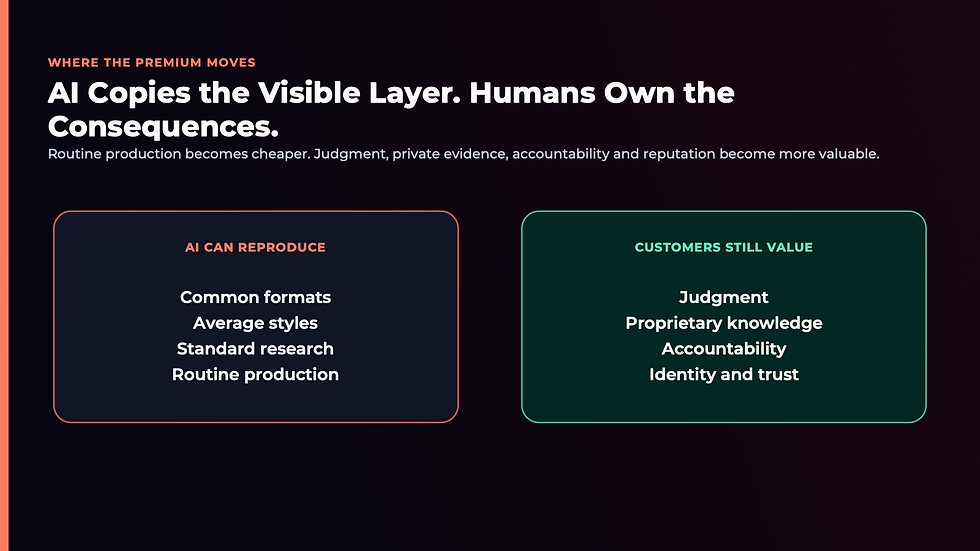
AI can imitate the visible layer of a business with extraordinary speed. It can reproduce common formats, average styles, standard research, familiar arguments and plausible recommendations.
That does not make human value disappear. It moves the premium.
PwC’s 2026 AI Jobs Barometer, based on more than one billion job advertisements, found that new tasks in AI-exposed roles were increasingly likely to rely on empathy, judgment and creativity. The same commercial shift applies to businesses: when routine production becomes cheaper, customers place more value on the capabilities that help them choose, trust and act.
Four layers become especially important.
1. Judgment
AI can generate twenty strategies. Judgment identifies the two worth testing and explains why the other eighteen are distractions.
This is why building an AI brain containing your customer evidence and operating rules matters. The tool supplies broad capability; your accumulated context improves the decision.
2. Proprietary knowledge
Public information is easy for competitors and customers to access. Your private customer interviews, performance history, process data, failure patterns and category experience are harder to reproduce.
AI can help you use that knowledge, but it does not automatically own the decade of evidence that created it.
3. Accountability
An AI system can recommend an action. It does not automatically stand in the meeting, accept responsibility, manage the fallout or remain beside the customer when implementation becomes uncomfortable.
Customers pay more when someone credible is willing to own the quality of the decision and the consequences of execution.
4. Identity and relationship
AI can imitate a writing style. It cannot inherit your reputation, relationships, lived history or the meaning people attach to your name.
That is why personal branding becomes more important as production becomes easier. A personal brand is not a headshot beside generic advice. It is the accumulated answer to four questions:
What do you consistently believe?
What standard do you refuse to compromise?
What experiences shape your judgment?
Why should customers trust you when the answer is uncertain?
The 2025 Edelman–LinkedIn B2B Thought Leadership Impact Report found that strong, perspective-shifting thought leadership helps lesser-known suppliers earn trust and turn skeptical internal decision-makers into advocates. Its detailed findings also show that buyers associate a distinctive format or style with higher-quality thinking.
Personality is therefore not decoration around the business. It is evidence that a particular human perspective exists behind the increasingly reproducible output.
How to Future-Proof Your Business From AI: Six Differentiation Strategies

The goal is not to hide from AI or compete with it at typing speed. Use it aggressively where it removes cost, then redirect the saved capacity toward value customers cannot obtain from the same generic tool.
1. Move from deliverables to diagnosis
If you sell blog posts, reports, graphics or plans, add the thinking that determines what should be produced.
For example:
replace “twelve monthly articles” with a search-opportunity diagnosis, editorial decisions, original interviews and performance review
replace “a sales deck” with positioning analysis, buyer objections, message testing and presentation coaching
replace “a financial dashboard” with anomaly detection, management decisions and monthly accountability
When production becomes abundant, judgment becomes the premium product.
2. Put the founder’s perspective at the front
Stop hiding your strongest opinions in private client calls while publishing interchangeable tips in public.
Name the patterns you see. Explain why popular advice fails. Show how you make decisions, who your approach is for and where you disagree with the category.
This is not permission to become loud for attention. A useful point of view gives the customer a better lens for understanding the problem.
Create three recurring brand assets:
Founder doctrines: concise beliefs customers can remember and repeat
Decision stories: moments showing how you evaluated a difficult trade-off
Signature frameworks: named methods that organize your expertise
AI can repeat the words after they exist. It cannot retroactively become the person whose experience gave those words authority.
3. Own the context AI cannot retrieve publicly
Build a controlled library of customer language, campaign results, approved examples, objections, failed experiments and decision rules.
This gives your internal AI systems better material while creating an information advantage customers cannot reproduce through a general prompt.
Do not confuse possession with usefulness. A folder containing 5,000 files is a storage unit, not an advantage. Organize the knowledge around real customer decisions and keep it current.
4. Sell implementation and accountability
Information is losing scarcity. Follow-through remains stubbornly human.
Add the elements that help customers cross the gap between knowing and doing:
scheduled implementation reviews
feedback on work produced between sessions
decision deadlines
quality scorecards
stakeholder alignment
adaptation when the first plan fails
This is also why a structured course can remain valuable even when free answers are everywhere. The value is not merely another lesson. It is sequence, practice, context and a defined implementation path.
5. Use AI to improve the customer experience, not merely your margin
Many businesses will adopt AI automation to reduce repetitive work, then quietly keep all the benefit.
Some of the savings should become customer value:
faster first responses
more personalized preparation
better meeting summaries
earlier risk detection
clearer progress reports
more time for high-value human conversations
Clients are less likely to replace you when AI makes the relationship more responsive, informed and useful.
6. Build a visible proof moat
A moat is simply something that makes the business harder to bypass. In this context, proof is stronger than claims.
Build:
specific case studies
before-and-after evidence
customer language and testimonials
public demonstrations of your reasoning
a community that creates peer value
consistent follow-up after the transaction
Then use AI agents for the surrounding research and preparation, while keeping consequential promises, customer relationships and public judgment under human control.
Your 30-Day Business Reinvention Plan
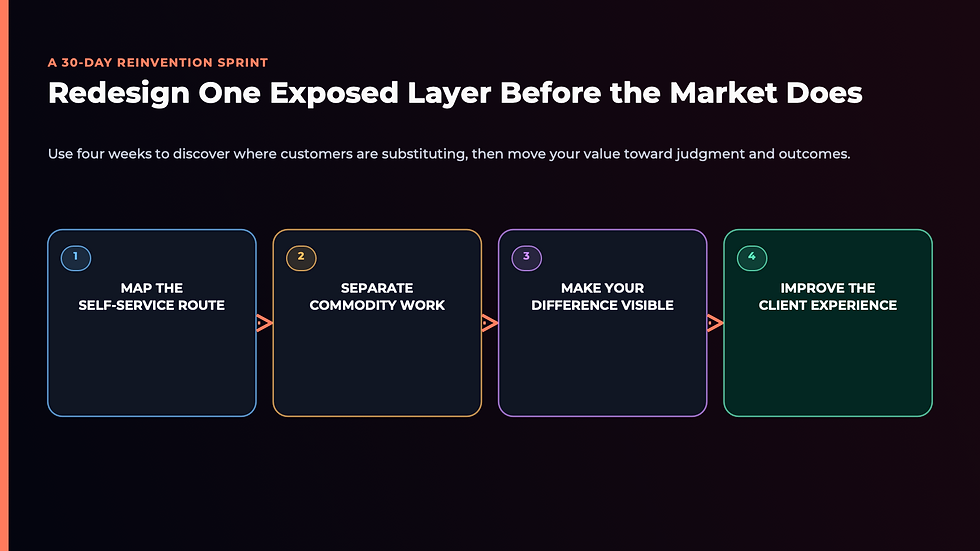
You do not need to rebuild the company this weekend. You need evidence about which part deserves to change first.
Week 1: Map the self-service route
Run the Client Substitution Test.
Ask five customers which parts of your offer they already attempt with AI.
Record what they consider good enough and what still makes them nervous.
Identify the deliverable most vulnerable to price pressure.
Week 2: Separate commodity work from premium judgment
List every step required to deliver the exposed offer.
Mark which steps AI can prepare safely.
Circle the steps requiring diagnosis, trust, negotiation, taste or accountability.
Rewrite the offer around those premium decisions.
Week 3: Make your differentiation visible
Publish one founder doctrine explaining what you believe the industry gets wrong.
Turn one client decision into an anonymized reasoning story.
Name one useful framework customers can apply immediately.
Replace one generic website claim with specific evidence.
Week 4: Improve the experience with AI
Choose one internal workflow that reduces delivery friction.
Give it clear inputs, a quality standard and a human approval point.
Turn the strongest recurring process into an AI loop that checks its work against your standard.
Return part of the saved time to the customer through better preparation, responsiveness or follow-through.
Review what customers noticed and what they valued.
If you want to turn these experiments into a repeatable system, the 28-Day AI Mastery Course provides the guided implementation path. The objective is to use AI before it is used against the weakest layer of your offer.
Before Your Market Becomes Self-Service

You may be reading this while thinking, “My clients still need me. They do not understand the work well enough to replace it.”
Chegg’s customers were not education experts either. They only needed an alternative that felt faster, cheaper and sufficient for the immediate job.
That is the uncomfortable standard. Customers do not have to reproduce your entire company. They have to remove enough of the paid process to make the old price or relationship harder to justify.
I have spent years helping entrepreneurs adapt to technology and behavioral change, and I keep returning to the same principle: when the tool becomes common, the quality of your judgment and the strength of your identity become more valuable.
That is one reason I wrote The Wolf Is at the Door. AI disruption is not only a technology story. It is a pressure test for what your business genuinely owns: customer trust, original knowledge, a recognizable worldview and the ability to guide people through decisions they cannot responsibly outsource.
Run the seven questions. Do not defend the current offer out of habit. Find the layer customers can already reproduce, use AI to reduce its cost inside your business, and move your human value closer to the decision that matters.
AI can imitate your output. It cannot inherit your reputation.
Frequently Asked Questions
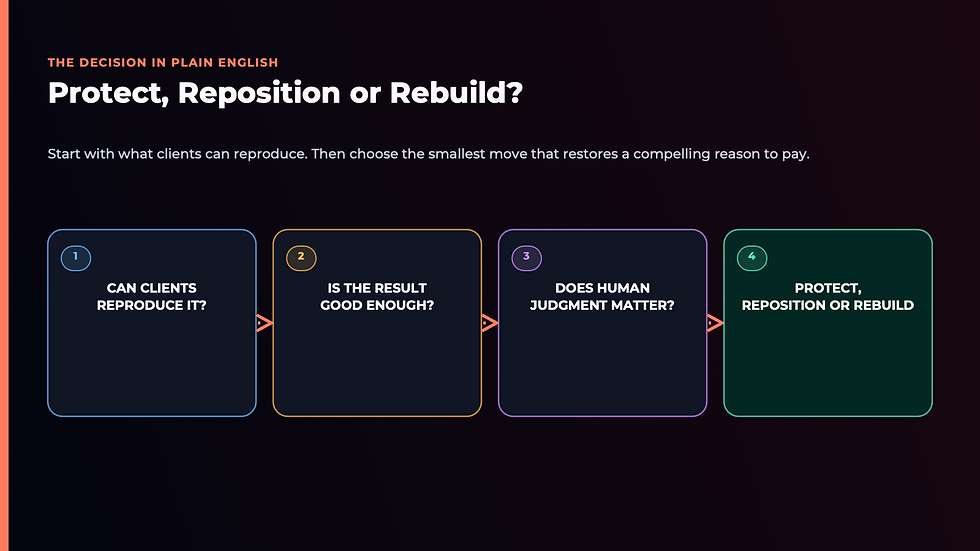
How can I future-proof my business from AI?
Identify which deliverables customers can reproduce with AI, then strengthen the value surrounding them: diagnosis, proprietary knowledge, implementation, accountability, relationships and a distinctive personal brand. Use AI internally to reduce commodity work and reinvest the savings in the customer experience.
How do I know whether AI can replace my business?
Assess whether customers can clearly describe the deliverable, provide the inputs, judge a good-enough result and tolerate mistakes. The more your pricing depends on standardized production rather than judgment or accountability, the higher the substitution risk.
Which businesses are most vulnerable to AI disruption?
Businesses face greater exposure when they sell standardized digital outputs created from public information and when customers can judge acceptable quality themselves. Generic content, basic design, routine analysis and information-only services are common examples, although exposure varies by customer and consequence.
Does personal branding really protect a business from AI?
A personal brand cannot prevent competition, but it can make expertise easier to recognize and trust. A distinctive worldview, demonstrated judgment, reputation and customer relationship are harder to substitute than an anonymous deliverable.
Can AI copy my personal brand?
AI can imitate visible patterns in your language or design. It cannot own your lived experience, customer relationships, verified results, reputation or accountability. Protect those assets by making them specific, visible and consistently connected to your name.
Should I lower my prices because AI makes production faster?
Do not automatically price by the hours required to produce the output. Reassess the value of the decision, risk reduction, implementation and outcome. If customers can obtain an equivalent result safely without you, however, the offer needs stronger differentiation rather than a cosmetic pricing defense.
Should I tell clients that I use AI?
Be transparent where AI affects confidentiality, accuracy, intellectual property, regulated work or the customer’s reasonable expectations. Your policy should explain where AI assists, how human review works and which decisions remain under your control.
Can adding AI to my current offer protect it?
Only when AI creates a better customer outcome or a new reason to choose you. Adding an AI feature to an offer customers can already replace will not automatically restore its value, as Chegg’s attempt to add AI to its existing model illustrates.
What should I do first if my business scores high on the Client Substitution Test?
Interview customers before rebuilding the offer. Ask what they already do with AI, where they distrust the result and which decisions still require expert help. Use those answers to move your offer from production toward diagnosis, implementation and accountability.


rr88 lúc đầu mình cũng hơi nghi ngờ vì mấy trang kiểu này hay bày biện rối rắm, nhưng vào thử trang chủ thì lại thấy họ làm khá gọn, chữ nghĩa vừa đủ, các khối nội dung xếp ngay hàng nên kéo xuống vẫn theo mạch; mình hay bị mỏi mắt khi gặp trang dài mà lộn xộn, ở đây thì đỡ hơn hẳn, đọc lướt cũng bắt được ý chính. Có đoạn họ nhắc nền tảng tham gia thị trường từ 2018 và đặt trụ sở ở Philippines, mình thích kiểu ghi cụ thể như vậy vì cảm giác ít nhất họ chịu đưa thông tin rõ ràng chứ không nói chung chung. Menu để chỗ dễ thấy,…
Trước đây mình hay liếc kết quả cho nhanh theo thói quen, nhưng càng về sau mình nhận ra cái mình cần hơn là lưu lại quá trình để biết mình đang suy luận hay chỉ đoán bừa theo cảm xúc. Từ ngày chịu khó ghi chép đều, mình thấy nhẹ đầu hơn hẳn vì có dữ liệu để so lại, không phải dựa vào trí nhớ lộn xộn. Có lần tình cờ đọc về Sổ kết quả 60 ngày, mình thấy hợp với kiểu người hay quên như mình, vì xem lại một lượt là thấy ngay những đoạn lặp và mấy lúc mình tự tưởng có “quy luật” gì đó. Dĩ nhiên mình không nghĩ có sổ là…