_edited.png)
AI Content Repurposing: Turn One Expert Idea Into a Week of Marketing


You finish a useful article, video or client answer, publish it once, then stare at an empty content calendar three days later. The idea was valuable. The distribution system was missing. That gap is what AI content repurposing should solve.
AI content repurposing is the controlled process of turning one verified source asset into several channel-specific pieces while preserving its central claim, evidence, voice and intended action. AI can extract, map and draft the variations. You still decide what is true, what deserves emphasis and what is ready to represent your business.
That distinction matters. When the system starts from your expertise, each derivative asset carries something competitors cannot prompt into existence. When it starts from a vague topic, AI merely produces more generic content at greater speed.
If you want to build this as a dependable operating system rather than another folder of prompts, Zero-Employee Entrepreneur is the program where I teach entrepreneurs to give AI a defined role, evidence and approval boundary. For this workflow, the role is a distribution editor: it multiplies an approved idea without inventing a new one.
In This Article
What AI Content Repurposing Actually Means

Repurposing is not asking ChatGPT to “turn this blog into five posts.” That instruction describes a quantity, not a standard. The model does not know which claim is indispensable, which example belongs to you, what each audience already understands or what action the next asset should earn.
A real repurposing system has four parts:
One source asset: an approved article, transcript, presentation, interview or customer explanation.
One message spine: the central problem, mechanism, proof and next action that must survive every format.
Several channel jobs: a short video earns attention, an email earns a click, a carousel makes a process scannable, and a LinkedIn post invites a professional conversation.
One approval gate: a person checks truth, voice, fit and readiness before anything leaves the draft state.
Think of the source as a tree and the derivatives as branches. A branch can grow in a different direction, but it still draws from the same trunk. If every branch becomes a different tree, you are no longer repurposing. You are generating unrelated content under a shared topic label.
This is why the workflow belongs beside a broader repeatable AI workflow. The prompt creates a draft. The workflow protects the relationship between the source, the channel and the final decision.
The immediate decision rule
Before repurposing any asset, finish this sentence:
After someone consumes the derivative, they should understand ______ and feel ready to ______.
If you cannot complete it precisely, the source is not ready to multiply. More formats will only spread the ambiguity.
Why Most Repurposed Content Feels Recycled
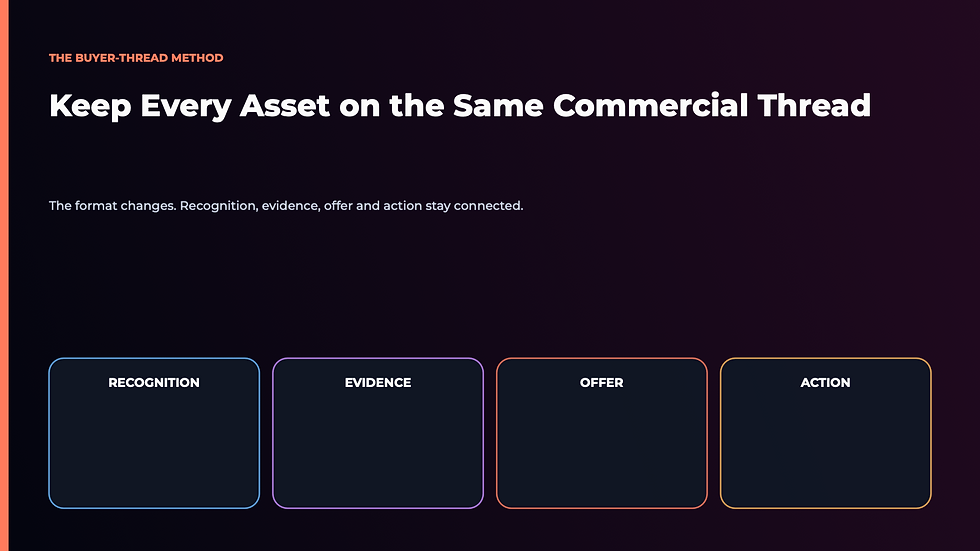
You have probably seen this failure: a long article becomes a shorter article, then a caption, then a thread. The wording changes, yet every version performs the same job. The audience experiences repetition because the system compressed the source instead of translating its value.
The hidden mechanism is message drift. Each new prompt creates a small distance from the original claim. After several generations, the sharp example becomes a generic lesson, the careful limitation disappears, and the call to action no longer matches the evidence.
I call the antidote commercial continuity. Recognition, evidence, offer and action must stay connected even when the format changes.
For example, imagine the source is a ten-minute video explaining why an entrepreneur should automate research before automating customer communication.
A Reel could dramatize the danger of sending a fast, unverified answer.
An email could tell the story of one confident mistake and invite the reader to inspect the full workflow.
A carousel could show the research, draft, proof and approval stages.
A LinkedIn post could ask owners which customer decisions they would never delegate.
Those assets are not copies. Each reveals a different facet of the same business truth.
This is also why “sound human” cannot be the final quality instruction. My guide to humanizing AI content explains the voice problem in more depth, but the practical standard is simple: retain the observation, tension and judgment that made the source worth publishing.
The default future if you skip this step
Without a message spine, your content calendar may look full while your market memory stays empty. People encounter many disconnected tips but cannot repeat what you believe, how you solve the problem or why your offer is the logical next step.
Volume creates impressions. Continuity creates recognition.
Build a Source Spine Before You Generate Anything

The best repurposing prompt is built after the evidence has been organized. Give the AI a short source spine it can quote, transform and check against.
Use these six fields:
Audience situation: What is happening in the reader's business when this idea becomes relevant?
Surface explanation: What do they currently think the problem is?
Hidden mechanism: What is actually creating the result?
Proof: Which example, demonstration, data point or first-party source makes the claim credible?
Boundary: What must the derivative avoid claiming, promising or implying?
Next action: What should the audience understand, try or explore next?
This is a miniature editorial brief. It prevents a model from treating every sentence in a long transcript as equally important. If your source material is scattered across files, first create a dependable context layer with an AI brain for your business. The goal is to make approved evidence easier to retrieve than remembered fragments.
A source-spine example
Suppose a consultant recorded a workshop on fixing weak sales pages.
Situation: qualified visitors reach the page but do not act.
Surface explanation: the owner thinks the button color or headline is the problem.
Hidden mechanism: the page asks for commitment before resolving the buyer's decision questions.
Proof: three customer interview excerpts and one before-and-after page review.
Boundary: do not promise a conversion lift or invent customer results.
Next action: reorder the page around recognition, mechanism, proof, offer and action.
That spine could produce a video about the hidden mechanism, a carousel showing the decision order and an email built around one interview excerpt. If you need the full page method, see my guide to using ChatGPT for sales pages.
What the AI may and may not add
Allow it to add transitions, channel conventions, shorter examples drawn from the approved source and alternative hooks that preserve the same claim. Do not allow it to add statistics, testimonials, personal experiences, product capabilities or guarantees that are absent from the source.
Google's guidance says generative AI can help with research and structure, while scaled pages that add little value can violate its spam policies. The useful line is not “AI or no AI.” It is whether the final material offers accuracy, quality and relevance rather than unoriginal output produced mainly to manipulate rankings.
Run the Five-Pass Repurposing Workflow
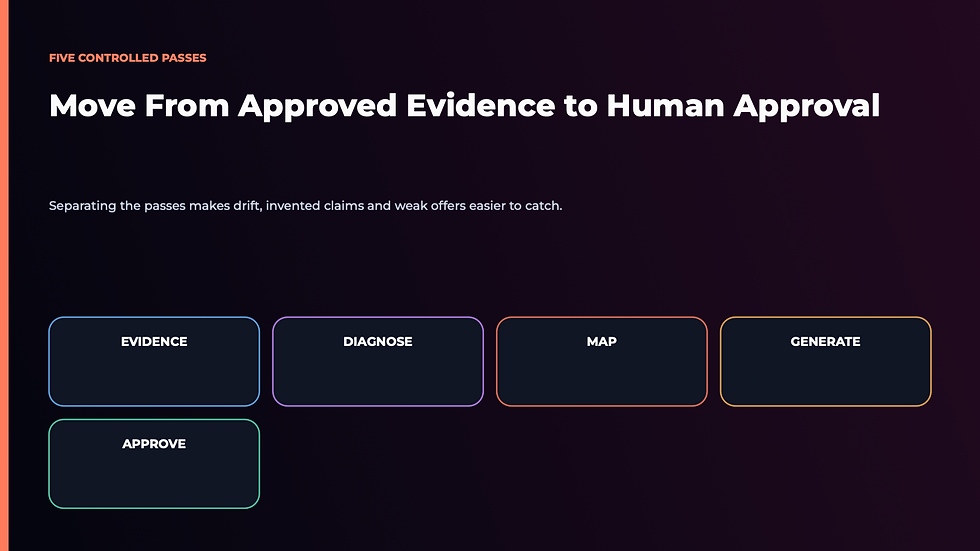
Do not ask for every derivative in one giant prompt. Separate the work into passes so you can see where quality breaks.
Pass 1: Extract
Ask the AI to identify the source's central claim, strongest proof, named mechanisms, memorable lines, objections and intended next action. Require citations to timestamps, paragraph numbers or section headings inside the source.
The result is an evidence map, not publishable copy.
Pass 2: Diagnose
Choose the audience situation and the single idea worth distributing this week. Reject anything that depends on invented context or repeats a recent campaign.
A useful instruction is: “Show me what this source uniquely helps the audience decide. Exclude general tips that could have been written without it.”
Pass 3: Map
Assign one job to each channel. Do not begin drafting until every proposed asset has a purpose.
Reel: earn attention with the sharpest tension.
Email: deepen recognition and earn a click.
Carousel: make the operating sequence scannable.
LinkedIn: frame a professional decision and invite response.
Blog update: answer the durable search question in full.
Pass 4: Generate
Draft one format at a time using the same source spine. Tell the AI which phrases, examples and boundaries must survive. Give it a length range and a real destination, but do not let a character count become the editorial strategy.
Pass 5: Approve
Compare each draft with the source, not with the previous derivative. Check four things:
Truth: Can every factual claim be traced?
Continuity: Is the central mechanism still intact?
Channel fit: Does the asset do a job native to this format?
Voice: Is there a specific human observation or decision in it?
This human review is consistent with the NIST Generative AI risk-management profile, which emphasizes testing, evaluation, verification and documentation rather than blind deployment.
Repurpose from the source, not from the last derivative. That one rule prevents a chain of increasingly polished errors.
Adapt the Job, Not Just the Word Count

Channel adaptation starts with audience behavior. A person opening an email has given you more attention than someone encountering a Reel. A person searching Google has a clearer question than someone scrolling LinkedIn. The same idea must therefore enter through a different door.
Short video: create a clean tension
Use one recognizable moment, one consequence and one useful turn. A 45-second video cannot responsibly carry every caveat from a 2,000-word article, so link to the complete explanation when the boundary matters.
Do not let the model create a theatrical confession you never made. Give it real language from the transcript or record a fresh sentence in your own voice.
Email: carry the reader from recognition to action
An email can hold more emotional movement. Start with the situation, expose the hidden mechanism, show one proof point and make the click feel like the natural continuation. Avoid summarizing the whole source; curiosity disappears when the email resolves every question.
Carousel: make the mechanism visible
Each slide should advance one step in the reader's understanding. A carousel is excellent for a sequence, contrast, scorecard or diagnostic. It is poor at carrying a dense argument split into arbitrary chunks.
LinkedIn: expose the business decision
Lead with the choice an owner or team faces. Explain the trade-off, show the operating rule and end with a question people can answer from experience. Professional relevance matters more than sounding profound.
Search article: satisfy the whole question
A blog post should define the topic directly, explain how it works, show limits and give the reader a usable implementation path. That durable depth is why the article remains the source asset rather than merely another output.
If you are creating campaigns with multimodal tools, my Google AI Studio marketing workflow shows how to keep the buyer thread intact across formats.
Use This 60-Minute Implementation Plan

You do not need a complicated automation to test the method. Start manually with one approved source and one AI workspace.
Minutes 0–10: choose the source
Pick an asset that already contains a distinct point of view, real evidence and a relevant next action. A client explanation you have repeated ten times may be stronger than your longest blog post.
Minutes 10–20: write the source spine
Complete the six fields: situation, surface explanation, hidden mechanism, proof, boundary and action. Link or paste the exact source. Mark anything that is outdated or confidential.
Minutes 20–30: create the channel map
Choose no more than three derivatives for the first test. Give each a job, audience state, target length and destination. If two assets have the same job, remove one.
Minutes 30–45: draft in separate passes
Generate one asset, review it against the source, correct the instruction, then move to the next format. Save the correction because it may become a reusable operating rule.
Minutes 45–55: run the four checks
Score truth, continuity, channel fit and voice from zero to two. Any asset scoring below six out of eight returns to draft. Any untraceable factual claim is an automatic stop.
Minutes 55–60: approve the queue
Name the owner and next state of each asset: revise, approve, schedule or reject. Do not let “generated” masquerade as “finished.”
Once this manual test is reliable, Zero-Employee Entrepreneur can help you turn the sequence into a specialist with clear inputs, outputs and approval rules. The objective is not to remove your judgment. It is to stop spending your judgment on blank-page work the system can prepare.
The Standard I Want You to Keep

I understand why content repurposing is attractive. When you are the strategist, expert, marketer and operator, a good idea can disappear beneath tomorrow's workload before it reaches half the people it could help.
But multiplying your words is not the real opportunity. The opportunity is to multiply your judgment without diluting it.
That requires a slightly higher standard than “this sounds like me.” Ask whether the asset preserves the business truth you were trying to teach. Ask whether its evidence can survive scrutiny. Ask whether the next action is earned.
In The Wolf Is at the Door, I write about the decisions entrepreneurs face as AI changes the competitive landscape. This is one of those decisions: will you use AI to fill more space, or will you build a system that carries your strongest thinking farther?
Choose the second. Give the system one verified source, one commercial thread and one human gate. Then let it earn the right to expand.
AI Content Repurposing FAQs

What is the best content to repurpose with AI?
Start with content that contains a clear claim, first-hand expertise, usable proof and a logical next action. Recorded workshops, detailed articles, interviews, customer explanations and original research are usually stronger sources than generic social posts.
Can AI repurpose videos into blogs and social posts?
Yes. Transcribe the video, identify the central claim and evidence, then create separate briefs for the blog and social assets. Review every factual claim against the recording because transcription errors and model improvisation can change the meaning.
Does repurposed AI content hurt SEO?
Using AI is not automatically the problem. Publishing many unoriginal pages with little added value is. A search article should fully answer a real question, add first-hand knowledge and receive human review rather than merely expanding a transcript.
How many pieces of content should one source create?
There is no useful universal number. Create only the formats that have a distinct audience job and enough source evidence. Three strong derivatives are more valuable than twenty near-duplicates.
Who owns content created with AI?
Ownership depends on jurisdiction and the human contribution. The U.S. Copyright Office says AI assistance does not automatically prevent copyright protection, but prompts alone do not supply sufficient human control. Its current position gives more weight to human-authored expression, selection, arrangement and modification. Read the full Copyright Office AI report announcement, and see my practical guide to who owns AI-generated content.
Should AI publish repurposed content automatically?
Begin with drafts. Publishing, customer communication, legal claims and performance promises should remain behind a human approval gate until the system has been tested, its sources are dependable and its mistakes are visible.


Comments