_edited.png)
How to Make Money with AI: 4 Founders Who Turned $0 into $80 Million — Without a Single Employee

Four founders. $80 million. Zero employees. If you want to know how to make money with AI, stop reading listicles about "15 side hustles" and start studying the people who already did it — with receipts. Every case study below is verified by Forbes and Business Insider, and I've broken each one down to the specific move that made the difference — not the obvious part. The part nobody's talking about. I walk through all four in this week's video above, free prompts included.
What's in This Article
1. Build What 99% of People Can't (Lovable — $400M ARR)
Most "how to make money with AI" advice tells you to freelance or flip templates. That's fine. But the biggest money isn't in using AI tools — it's in removing a barrier that locks millions of people out of an entire industry.
Anton Osika and Fabian Hedin launched Lovable, a platform where you describe what you want in plain English and AI builds you a working app. Forbes called it the fastest-growing software startup ever — $100M in annual revenue within eight months. By February 2026, they hit $400 million ARR with just 146 employees.
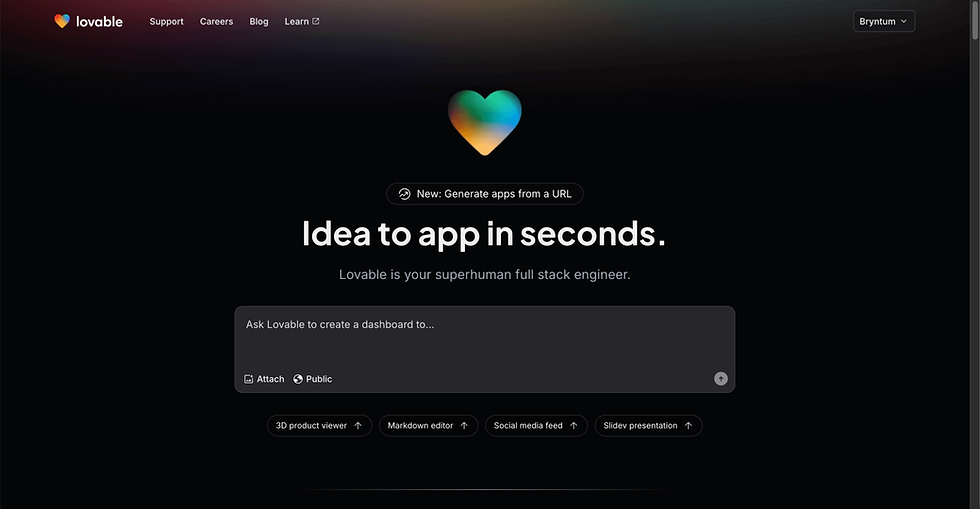
Here's where it gets interesting. They didn't build a better coding tool — the market is flooded with those. They identified that 99% of people with a business idea hit the same wall: "I can't code it." One Lovable user built a restaurant management tool and generated over $120,000 in sales (Forbes). Not a developer. A person with a problem and a prompt.
The hack isn't the tool — it's the thinking. That's the entire premise of The Wolf Is at the Door. AI doesn't replace your thinking. It exposes whether you were thinking critically in the first place.
Your move: Open any AI tool and paste this: "What are the top 5 tasks in [your industry] that people currently pay a professional to do, but could be handled by an AI-powered app with a simple interface?" That's your product roadmap.
2. Know Where the Line Is (Klarna — $40M Profit Improvement)
Klarna deployed an OpenAI-powered chatbot that handled 2.3 million customer conversations in its first month — the work of 700 full-time agents. Resolution time dropped from 11 minutes to under 2. The financial impact? $40 million in profit improvement that year.

And then they walked it back. Klarna rehired humans. Their CEO admitted that cost had been "too predominant" as a factor. Everyone talks about the $40 million headline. Almost nobody talks about the retreat.
In chapter 2 of The Wolf Is at the Door, I call this cruel optimism — the belief that AI will magically fix everything without you thinking critically about where it actually belongs. Klarna learned the expensive way. You don't have to. The real money isn't in automating everything — it's in knowing exactly which 80% of conversations are repetitive enough for AI to handle flawlessly, and protecting the 20% where a human still wins. Makes sense, right?
If you want to learn how to make money with AI in your service business, this is the framework. Map the repetitive, automate the predictable, protect the human.
Your move: List every customer interaction your business handles in a week. Then ask AI: "Sort these into two categories — conversations that follow a predictable script, and conversations that require empathy, judgment, or nuance. For the scripted ones, draft response templates I can load into a chatbot." That's the balance Klarna spent $40 million discovering.
3. The One-Person, $80 Million Exit (Base44 — Solo Founder)
Maor Shlomo built Base44 — alone. No team. No funding. Zero employees. The platform let businesses create custom apps through conversational prompts, and it grew so fast it outpaced what a single person could manage. Within six months he was making $189,000 in profit per month. Then Wix acquired him for roughly $80 million. Forbes covered it two weeks ago.

Most people hear this and think the lesson is "work alone and use AI." That's not it. The lesson is that the old gatekeepers — funding, hiring, office space, infrastructure — are gone. The gap between "idea" and "acquisition" collapsed from years to months. Shlomo didn't build slowly and raise capital. He built fast, proved revenue, and someone wrote an $80 million check. For AI agents and entrepreneurs, this is the new playbook.
Your move: Map every workflow in your business that currently requires more than one person or more than two hours a week. Ask AI: "Which of these could an AI agent handle end-to-end with less than 20% human oversight? For each one, outline the setup steps." That's your AI productivity roadmap — and what turned a solo founder into an eight-figure exit.
4. Multiply Your Best Self (Rowan Cheung — $7M Projected)
Rowan Cheung dropped out of college, started an AI newsletter, and hit $3 million in revenue by 2024 — $7 million projected for 2025. Fifteen people operating like a team of fifty.

Here's the thing nobody tells you about making money with AI content. Most people open ChatGPT and say "write me a LinkedIn post." Then they wonder why it sounds like everyone else. Cheung did the opposite. He exported his best-performing tweets, fed them into a Claude project, and trained the AI specifically on his voice — his patterns, his hooks, the writing that already resonated (EO Magazine). Then he cloned his face and voice with an AI avatar tool and scaled to over 100,000 Instagram followers — without filming a single video himself. Most people walk right past this.
The difference isn't AI-generated content versus human content. It's whether you feed the machine your winners or start from zero every time.
Your move: Pull your five best-performing posts — emails, tweets, videos, whatever got the most engagement. Paste them into ChatGPT or Claude and say: "Analyze the patterns across these five pieces — tone, structure, hooks, sentence length, word choice. Then generate three new pieces in exactly this style on [your next topic]." That's not AI writing for you. That's AI scaling what already works.
The Real AI Strategy You're Sitting On

These four didn't use more tools than everyone else. They used them in the places that created the most financial leverage — removing barriers, knowing where the line is, collapsing the gap between idea and revenue, and multiplying their best work instead of generating average work.
In The Wolf Is at the Door, I wrote that AI got an upgrade — which means we must, too. The question isn't whether AI can make you money. It's whether you'll deploy it where it actually matters, or keep using it like a spellchecker.
If you want the full system — research, automation, content, and a live dashboard that shows you what's actually working — the 28-Day AI Mastery Course walks you through it step by step. No prior experience needed.
Frequently Asked Questions About How to Make Money with AI
How can beginners make money with AI in 2026?
Start with what you already know. Use AI to automate repetitive tasks in your current work, then package that automation as a service. Lovable proved that you don't need technical skills — you need a clear problem and the right prompt. For a structured starting point, the 28-Day AI Mastery Course covers the fundamentals.
What is the fastest way to make money with AI?
The fastest path is automating high-volume, repetitive customer interactions — exactly what Klarna did to generate a $40 million profit improvement. Map your most common customer touchpoints, build AI response templates, and deploy a chatbot for the predictable 80%.
Can one person really build a million-dollar AI business?
Yes. Maor Shlomo built Base44 alone and was acquired for $80 million within six months (Forbes). The key is using AI agents to replace entire workflows, not just individual tasks.
What AI tools do successful entrepreneurs actually use?
The tools matter less than the strategy. Cheung uses Claude for content. Lovable is built on Anthropic's models. Klarna partnered with OpenAI. The common thread is deploying AI where it creates financial leverage — not just convenience. For a breakdown of the best tools by use case, see 7 Powerful AI Tools for Entrepreneurs.
Is it too late to start making money with AI?
No. The gap between "idea" and "revenue" is the smallest it's ever been. Base44 launched in late 2024 and was acquired for $80 million by mid-2025. Lovable went from zero to $400 million ARR in under 18 months. If anything, 2026 is earlier than you think. For a deeper look at where this is headed, I break it down in The Wolf Is at the Door.
How much money can you realistically make with AI?
That depends entirely on where you deploy it. Freelancers using AI for content or automation typically earn $1,000–$8,000/month (Printify). Founders building AI-native products — like the four in this article — have generated millions. The difference is leverage: are you using AI to do tasks faster, or to remove barriers at scale?


Ragdoll Hit has a way of turning frustration into pure laughter.
Tiny fishing is one of those games that benefits from being simple — there's no fat to trim because nothing unnecessary exists.
Finishing a tough Level Devil level gives me more satisfaction than most things in my daily life 😅