_edited.png)
Claude Watermark: What It Means for Your Work, Clients and Reputation


The Claude watermark becomes real the moment somebody questions work you know you shaped. Imagine sending a proposal you spent six hours building. You supplied the strategy, rejected three weak directions, checked every claim and rewrote the conclusion. Claude helped you tighten the language.
Then a client runs the file through a future verification tool and sees a mark: processed by Claude.
The accusation arrives before the conversation does. Did you write this? Were you hiding AI? Did I pay for your judgment or for a prompt?
That is why the Claude watermark matters. Anthropic is starting to add hidden markers to some Claude-generated text, images and files, making it possible to identify when Claude may have been involved.
New models launched in the European Union on or after August 2, 2026 are designed to support marking from launch; earlier models are moving through a transition period. So you should not assume that every Claude output already carries a detectable mark. Where marking is supported, the signal can travel with copied text and may survive some editing.
But Anthropic also says a positive result only means the content may have been processed by Claude and is “not fully conclusive.” Claude might have drafted it, proofread it, translated it or touched one paragraph. A missing mark does not prove that AI was absent either.
A watermark can prove contact with AI. It cannot measure ownership of the thinking.
That distinction will become commercially important. The question is no longer simply, “Can somebody detect AI?” It is, “Can you show what you contributed, what you verified and what you disclosed?”
If your current process is still a private chat followed by a polished deliverable, the 28-Day AI Mastery Course shows you how to turn AI into a governed workflow—with source checks, human approvals and a clear record of where your judgment enters the work.
In This Article
What Is the Claude Watermark?

Anthropic describes two related systems in its official explanation of Claude’s content marks.
Text from a supported Claude model receives an imperceptible model-level watermark. Think of it as a pattern woven into the output rather than a visible label pasted beneath it. When somebody copies the text into a document or another application, the pattern may travel with the words and can survive some edits.
Supported files and images can receive signed C2PA provenance metadata. C2PA is an industry standard for recording where digital content came from and how it changed. It behaves more like a tamper-evident label attached to a digital asset—although metadata can disappear when a platform strips it or the file is converted.
Anthropic says the marking works worldwide wherever a supported model is offered, including Claude, Claude Code, Cowork and the API. Its current rollout boundary matters: models launched in the European Union on or after August 2, 2026 support marking from launch, while models released before that date fall under a transition period and are still being brought into coverage. That is different from saying every model currently available already marks every output.
The timing is not accidental. The European Commission’s transparency code supports compliance with Article 50 of the AI Act, whose marking and labelling obligations began applying on August 2, 2026. Providers are expected to make generated or manipulated outputs machine-readable and detectable where technically feasible.
But do not turn a technical signal into a moral verdict. Anthropic has not yet released its public or third-party detection mechanism. It also warns that the mark can be weakened by heavy rewriting, paraphrasing, translation, mixing with other text or simply having too little text to analyse.
The mark is a clue about the production chain. It is not a CCTV recording of who did the thinking.
Why People Are Angry About It

The backlash reported by TechCrunch is revealing because people are arguing about two different things.
One group fears a digital scarlet letter. A student, journalist, writer or employee could be treated as dishonest because a tool touched the text—even when the human supplied the argument, facts, decisions and revisions. One Reddit user’s complaint captured that frustration: “I gave the instructions, context, decisions, and countless refinements, Claude was the tool.”
Another group sees the anger as evidence that people were concealing AI use. If a person submits generated work as entirely their own, a durable provenance signal could protect employers, teachers, clients and readers. One reaction boiled the argument down to a blunt point: if there is nothing deceptive happening, why hide the tool?
Those reactions are anecdotes, not a representative survey. Still, the conflict exposes the missing unit in most AI policies: contribution.
“AI was used” tells you almost nothing about the human contribution. A spellchecker and a one-click report generator both use software, but nobody values them equally. The same is true inside Claude. Asking it to correct a typo is different from asking it to invent the analysis, sources and conclusion.
This is where workplaces and schools will make mistakes. They will be tempted to create a binary rule for a spectrum of activity.
The better question is not, “Did AI touch this?” It is, “What intellectual responsibility did the person retain?”
A Claude Watermark Is Not an AI Detector

This is the technical distinction most coverage will blur.
An ordinary AI detector looks at finished language and estimates whether its statistical patterns resemble machine-generated text. It is guessing from the surface. A watermark is a deliberate signal inserted during generation. It starts with privileged information from inside the system.
Imagine airport security. A detector is an officer studying a bag and deciding whether it looks suspicious. A watermark is a baggage tag attached by the airline when the bag enters the system. The tag gives you stronger provenance, but it still does not tell you who packed every item or why the trip occurred.
That is why Anthropic’s own wording matters. A positive mark may show that Claude processed the content. It does not prove that Claude authored every sentence, that a policy was broken or that the human contributed no original judgment.
It also does not solve the authorship question when a person moves between tools. A founder may research in Perplexity, outline in Claude, draft manually, check facts in primary sources and proofread in another model. Which system “wrote” the work?
The answer is not hiding in punctuation. It is in the workflow.
For entrepreneurs, the practical lesson is familiar from prompt-injection risk: a technical control is only useful when you understand what it can and cannot authorize. Provenance should trigger review, not automatic punishment.
Why AI Detectors Still Fail

AI detectors are often sold as certainty machines. The research tells a less comfortable story.
The usual detector is trained or calibrated on examples of human-written and AI-generated text, then asked to separate the two. But large language models learned from enormous amounts of human language and are designed to imitate it. Human and machine writing therefore overlap by design. Add editing, translation, domain vocabulary or a writer whose English does not match the training data, and the boundary becomes unstable.
In 2023, researchers led by Stanford’s Weixin Liang tested seven detectors and found a serious bias against non-native English writers. The detectors performed almost perfectly on essays by US eighth graders but frequently misclassified TOEFL essays written by non-native speakers. In a separate stress test, the researchers used ChatGPT to simplify the native-speaker essays before running detection; the average false-positive rate then jumped from 5.19% to 56.65%, according to their published study. That second result was not untouched human writing, but it showed how strongly a change in linguistic style could move the detector’s verdict.
A separate evaluation by Debora Weber-Wulff and colleagues tested twelve public tools plus two commercial systems. Their conclusion was direct: the systems were neither accurate nor reliable, and efforts to disguise or edit generated text made the results worse. The study’s benchmark included both human and machine-generated documents rather than assuming one platform’s score represented ground truth.
The problem has not disappeared as detectors improved. In an ACL 2025 study of 15,000 samples, Swarnadeep Saha and Soheil Feizi found that detectors frequently flagged even minimally AI-polished human writing as generated and struggled to distinguish different levels of AI involvement. Their paper on AI-polished text matters because polishing is precisely how many responsible professionals use these tools.
Another 2025 evaluation tested detectors on unfamiliar domains and models, then subjected them to practical attacks. At a strict one-percent false-positive rate, some true-positive rates fell as low as zero. The NAACL findings are a warning against importing a detector score into an employment, academic or client decision as if it were a fingerprint.
The danger became concrete in Newby v. Adelphi University. According to the New York court’s January 28, 2026 decision, Adelphi freshman Orion Newby submitted a World Civilization essay on November 7, 2024 after working with a tutor through the university’s Bridges Program. Turnitin returned an “AI-generated score of 100%.” Newby received a zero, was found responsible for an academic-integrity violation and was ordered to complete a plagiarism workshop within 30 days or face a registration hold.
Newby denied using generative AI to write the essay. He pointed to his tutoring process, written objections and two other detector results his parents obtained that labelled the work human-written. Those competing detector scores did not establish authorship either, but the university failed to meaningfully weigh his evidence and its own professor later questioned how the case had been handled. The court annulled the violation, rescinded the sanction and ordered Adelphi to expunge the academic record, finding that the decision lacked a valid basis and that the process denied Newby a meaningful opportunity to be heard.
This was a conventional after-the-fact detector dispute, not a Claude-watermark case. Anthropic has not released a public Claude watermark detector, and no real watermark accusation should be inferred from Newby’s experience. The case also does not prove that Turnitin is always wrong: the judgment turned on conflicting evidence, weak reasoning and procedural failures. It shows what can happen when a probabilistic signal is promoted into a verdict before the person’s process evidence is considered.
None of this means detection is useless. It means the output is evidence with limits.
When the consequence is serious, a probability score needs process evidence beside it.
LinkedIn and the AI Slop Contradiction

LinkedIn is a perfect example of the tension platforms have created.
LinkedIn previously encouraged AI-assisted writing through a Page-post rewriting tool. Its current Help documentation confirms that the feature is “no longer available” and says replacement post-writing tools are planned.
Then the feed filled with posts that sounded polished, familiar and strangely empty.
In June 2026, LinkedIn announced that it would reduce distribution for generic AI-generated content. Its official newsroom statement says it is acceptable to use AI for writing help, but posts and comments still need the author’s voice and perspective. LinkedIn reported that its initial testing identified generic content 94% of the time, although that is the company’s own testing result rather than an independent audit.
The irony became harder to miss when TechRadar reported that LinkedIn had added a “Seems like AI slop” option to the three-dot reporting menu and was replacing its AI rewrite feature with a proofreader intended to preserve the user’s voice. LinkedIn has officially confirmed the broader anti-generic-content policy and, separately, the withdrawal of its Page-post rewrite tool; the button itself is, at the time of writing, supported by reporting rather than the newsroom announcement.
LinkedIn’s contradiction is also the market’s contradiction: platforms pushed people toward faster production, then began penalising the sameness that followed.
The failure was never simply that people used AI. It was that AI removed the human residue—the observation, risk, specificity and experience that makes a post worth reading.
The guide to the psychological impact of AI explores the deeper pressure behind this behaviour: when output becomes effortless, people can feel compelled to produce more even as the work becomes less meaningful.
What This Changes for Your Job, Clients and Content
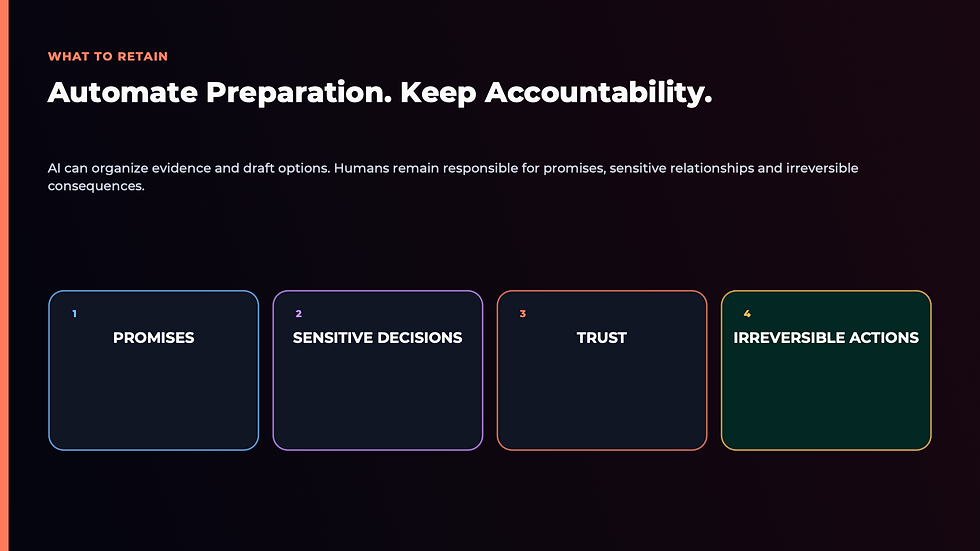
If most of your value is in typing sentences, provenance will feel threatening. If your value is in diagnosis, judgment, verification and results, it can become protective.
Consider four common situations.
A consultant uses Claude to turn interview notes into a first draft. The real value is knowing which customer problem matters, challenging a weak assumption and recommending the correct decision. The consultant should be able to show those inputs and checks.
An employee uses Claude to summarise a report they did not read. They cannot defend the numbers in a meeting. The watermark did not cause the problem; it exposed a workflow that had already outsourced responsibility.
A student asks Claude to correct grammar in an original essay. A detector or watermark may still trigger suspicion even though the argument and research are theirs. A version history and disclosure can separate assistance from substitution.
A creator publishes ten generic posts a day. Even if no watermark is ever detected, readers and platforms may down-rank the content because it carries no lived observation. The commercial penalty arrives before the technical verdict.
This is why AI skills for entrepreneurs must now include provenance literacy. You need to know what a model did, what you retained and what evidence you could produce if the work were challenged.
There is also a second-order consequence: clients will begin asking for “human-written” work without defining the phrase. Do not accept a vague standard. Agree on the permitted workflow instead. Can AI organise notes? Suggest alternatives? Rewrite for clarity? Generate final copy? Access confidential information? Those are answerable questions.
“No AI” is a slogan. A permission map is a policy.
Build a Trust Receipt for Every Important Deliverable
You do not need to save every prompt. You need enough evidence to reconstruct the responsible chain of work.
Use a Trust Receipt with three fields:
Contribution: What did the human originate—research question, source material, analysis, decision, examples, conclusion?
Verification: What was checked—facts, calculations, citations, permissions, tone, confidentiality and final output?
Disclosure: What does the audience, employer, teacher or client need to know about AI assistance?
For a client proposal, the receipt might say: Ben defined the offer strategy and recommendations; Claude reorganised interview notes and produced two structural options; Ben checked every figure, rewrote the final recommendation and approved the document.
For a blog post, it might record: primary sources selected by the editor; AI used to compare research and find gaps; quotations checked against originals; article rewritten and approved by the named author.
For an internal email, a simpler note may be enough: AI proofread only; sender approved final wording.
This is not bureaucratic theatre. It is a defence against the binary assumptions a watermark invites.
The system also improves the work. Once contribution and verification are visible, you can see whether AI is removing low-value effort or quietly replacing the expertise customers pay for.
If you want to build this into repeatable content, sales and operating workflows, the 28-Day AI Mastery Course helps you define those roles and approval boundaries before the next platform policy forces the decision for you.
How to Use Claude Without Hiding the Thinking

Start with the work that would be most damaging to defend poorly: a client deliverable, academic submission, public claim, financial recommendation or piece of thought leadership.
Write one sentence describing the human job. For example: “I own the analysis, source selection and final recommendation.”
Then write one sentence describing Claude’s job: “Claude may organise notes, challenge gaps and improve clarity, but may not invent evidence or make the final decision.”
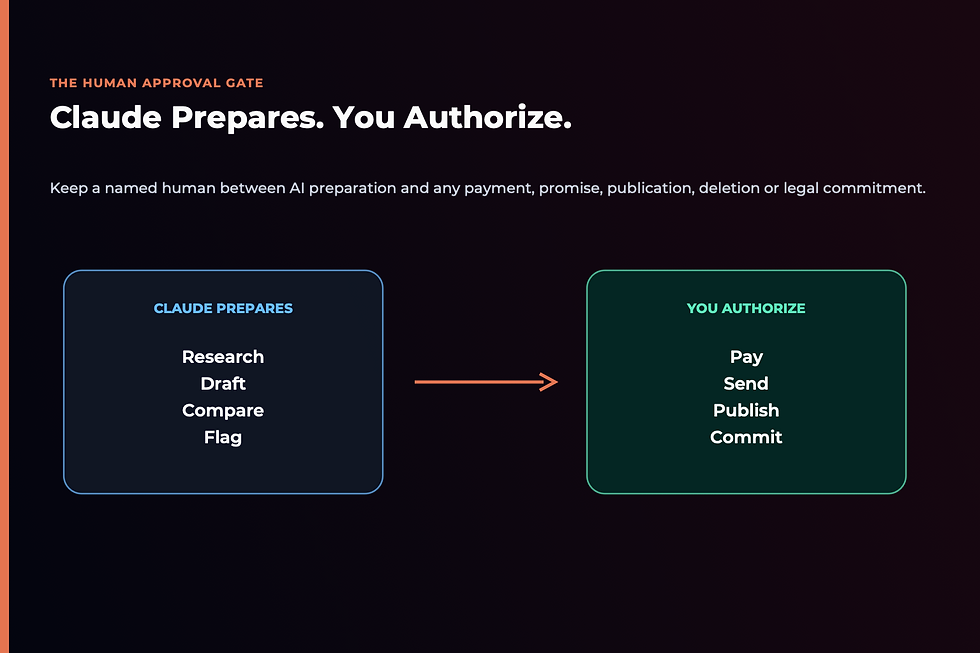
Set approval boundaries. Publishing, spending, deleting, submitting assessed work and making external commitments should remain human decisions. Reversible support work—sorting notes, comparing drafts, flagging missing citations—can usually move faster.
Save the meaningful evidence: original notes, source links, version history, final approval and the Trust Receipt. Do not create a surveillance archive of every keystroke. Create enough context to defend the integrity of the result.
Finally, judge the output by reader value. A clean provenance trail will not rescue an empty article, a generic LinkedIn post or a proposal that says nothing. The strongest protection is still recognisable human judgment.
This is also how to get more from Claude for small business or ChatGPT for small business: give the model a defined role inside a workflow rather than asking it to impersonate the person accountable for the outcome.
A Personal Note From Ben

I use AI deeply in my business. I also know the moment when a useful tool becomes a hiding place.
It happens when I stop making the hard decision and start polishing the system around it. Another prompt. Another agent. Another rewrite. The document gets smoother while the commercial judgment gets weaker.
That is why the Claude watermark does not frighten me as much as the absence of a defensible process. If somebody asks what I contributed, I want a better answer than, “I typed the prompt.” I want to show the research I selected, the weak ideas I rejected, the conclusion I was willing to own and the final check that kept a machine’s confidence from becoming my mistake.
My doctrine is simple: AI may accelerate the work, but responsibility cannot be automated.
That is the same argument I explore in The Wolf Is at the Door. The threat is not a machine secretly becoming human. It is humans surrendering the capabilities that make their work valuable, then blaming the machine when trust collapses.
Use the tool. Keep the judgment. Leave a receipt.
Frequently Asked Questions

Can Claude watermark text I copy into another document?
Anthropic says the imperceptible text watermark travels with copy-and-paste and may survive some editing. Heavy rewriting, paraphrasing, translation, mixing with other text or using too little text can weaken detection.
Does a Claude watermark prove someone cheated?
No. Anthropic says a detected mark means content may have been processed by Claude and is not fully conclusive. It cannot, by itself, show whether Claude drafted the work, proofread it or translated a small portion.
Are AI detectors accurate enough to discipline an employee or student?
Detector output can support an investigation, but research shows false positives, domain sensitivity and weak performance after editing or attack. Serious decisions should include version history, source work, disclosure rules and a chance for the person to explain their process.
Should I stop using Claude for client work?
Usually no. Define what Claude may do, protect confidential data, verify the result and agree on disclosure requirements. The greater risk is using AI without a policy you can defend.
What should an AI-use policy say?
Specify permitted tasks, prohibited data, required verification, human approval points and disclosure expectations. Avoid a vague “no AI” rule unless the work genuinely requires it and the organisation can explain what counts as AI assistance.


Comments