_edited.png)
Too Old to Learn AI? A Practical Roadmap for Entrepreneurs Over 40


You open an AI tutorial because you want an answer to a question you rarely say aloud: am I too old to learn AI? Then a twenty-something creator races through agents, APIs and automations, and you quietly think: Maybe I have left this too late.
You are not afraid of hard work. You have built a career, a business, a network and a way of making decisions. But AI seems to arrive with a new vocabulary every week, and the people teaching it often make speed look like intelligence.
Here is the direct answer: you are not too old to learn AI. You may need a different learning design than someone who treats every new tool as entertainment, but your experience can make you better at the part that matters most: deciding what good work looks like, spotting weak answers and knowing where judgment cannot be outsourced.
I call this the Experience-to-AI Advantage: AI fluency is not a memory contest. It is the ability to turn experience into better instructions, checks and decisions.
If you want a structured, beginner-safe way to apply that principle to your own work, Ben Angel’s 28-Day AI Mastery course provides 40+ practical lessons for a $99 one-time payment with lifetime access. Whether you use that program, another course or a self-directed plan, the roadmap below will help you learn without pretending you need to become a programmer—or a different person.
In This Article
Why Age Feels Like the Problem—and What Actually Matters

The anxiety is understandable. AI tools change quickly. Interfaces get redesigned. New model names appear before you have finished learning the previous ones. Online tutorials assume you know the difference between a prompt, a model, an agent and an API.
When that complexity lands beside a younger creator saying, “This is easy,” age becomes the most available explanation for your discomfort.
But age often bundles together several different problems:
you are learning without a business outcome;
the lesson moves faster than your opportunity to practise;
the examples have nothing to do with your work;
you are trying to remember features instead of building one repeatable process;
you are comparing your first week with someone else’s hundredth tutorial.
Those are design problems, not proof that your brain has expired.
The wrong test of AI ability
If you measure yourself by how many tool names you can recall or how quickly you can copy a creator’s workflow, you will always feel behind. The market produces new features faster than any sensible person can absorb them.
The better test is practical: can you use one approved AI tool to improve a recurring task while preserving quality, privacy and human judgment?
That could mean turning rough voice notes into a first draft, comparing customer objections across interviews, building a research brief from primary sources or creating a documented handoff your team can repeat.
My guide to AI skills for entrepreneurs explains why task definition, verification and workflow design matter more than collecting tricks. Those skills are not reserved for digital natives. They grow from judgment.
The emotional stake is bigger than software
For many entrepreneurs over 40, the real fear is not “Will I understand ChatGPT?” It is “Will the experience I spent decades building become less valuable?”
That is why AI learning can trigger more than ordinary beginner discomfort. It can feel like an identity threat. The pressure described in the psychological impact of AI becomes sharper when a tool appears to compress work that once required years of expertise.
Do not answer that fear by denying the disruption. Some tasks will change. Some skills will lose market value. But experience does not disappear; its economic value shifts toward framing, evaluation, context and consequence.
What Changes After 40—and What Still Works in Your Favor
Age is real, so the useful answer cannot be a motivational slogan. Some aspects of cognition do change. You may need more repetitions for unfamiliar terminology or more recovery time after an overloaded day. That does not make meaningful learning impossible.
The US National Institute on Aging reports that some thinking abilities can decline with age while others remain stable or improve. Its summary of research involving more than 700 adults aged 58 to 98 found declines in processing speed and working memory alongside improvements in attention and executive function in that study. The NIA’s explanation of cognitive change is a useful reminder that “older” is not a single measure of learning capacity.
The exact pattern varies by person, health, context and task. A population study cannot predict how quickly you will learn a specific AI workflow. It does, however, contradict the lazy idea that every relevant ability moves in one direction after a certain birthday.
What may require a different approach
You may learn unfamiliar interfaces more slowly than someone who spends all day testing software. Working memory can be taxed when a lesson asks you to hold five new terms, three browser tabs and an abstract exercise at once.
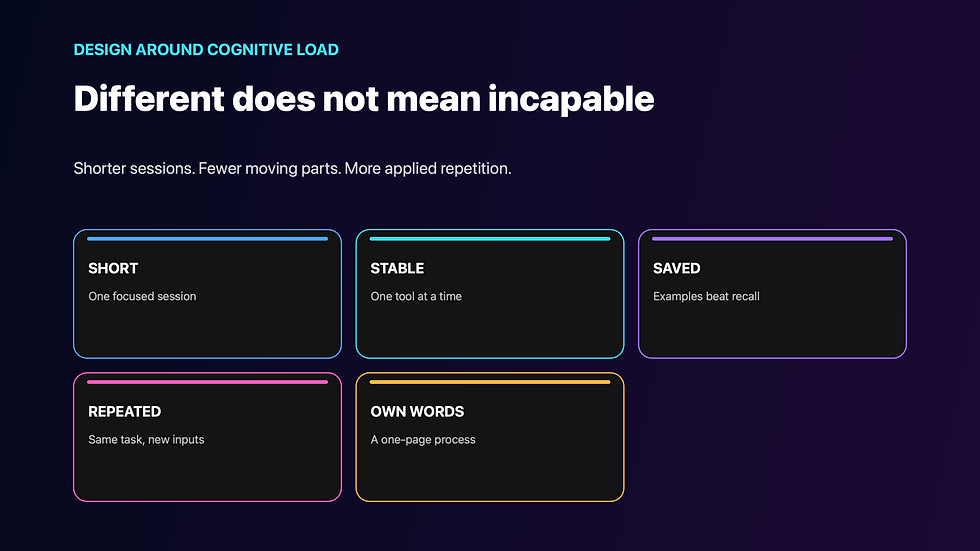
Design around that constraint:
use shorter sessions;
keep one tool open at a time;
save working examples instead of relying on recall;
repeat the same task with slightly different inputs;
write a one-page process in your own language.
This is not remedial learning. It is good workflow design.
What experience gives you
You know what a vague brief costs. You can hear when a customer answer is technically correct but emotionally wrong. You recognize the missing assumption in a forecast. You have seen apparently efficient systems fail because nobody owned the final decision.
Those are AI skills once translated into the new environment.
The OECD’s 2025 work on older workers recommends short, modular training connected to practical work problems and recognition of learning that happens on the job. Its guidance on skills and jobs for older workers supports a design that is applied, flexible and relevant—not an abstract race through technical content.
The lesson is simple: do not learn AI as a subject you must finish. Learn it as a capability you apply to a problem you already understand.
The Experience-to-AI Advantage

Experience becomes an advantage only when you make it visible. If your standards remain intuitive and unspoken, the AI cannot use them and another person cannot repeat them.
Use this three-part loop.
1. Specify the judgment
Choose a task you understand well. Before prompting, write down what a good result must include, what it must avoid and what would make you reject it.
For a sales follow-up, you might require a clear next step, accurate reference to the conversation and no invented urgency. For research, you might require primary sources, dates and a separation between evidence and inference.
This turns instinct into instruction.
2. Inspect the gap
Run the task and compare the output with your standard. Do not ask only, “Do I like this?” Name the gap. Is the answer generic? Did it miss a commercial constraint? Did it flatten the customer’s emotional language? Did it make a claim without evidence?
Your correction is the lesson. Each specific failure teaches you how to improve the instruction, source material or review gate.
3. Encode what you learned
Save the final prompt, example, checklist and stopping rule in one place. This is the beginning of an AI workflow, not merely a successful conversation with a chatbot.
The next time you run it, measure whether the process produces acceptable work with less correction. If it does, keep it. If it does not, repair or retire it.
This is Ben doctrine: your age becomes a disadvantage only when experience hardens into refusal instead of becoming a better filter. The goal is not to prove that you can keep up with every tool. It is to make your existing judgment more usable and more scalable.
Choose one micro-decision
Do not begin with “I need to learn AI.” That goal is too large to complete and too vague to measure.
Choose one recurring business decision for the next seven days: the research you approve, the draft you revise, the meeting notes you convert into actions or the customer questions you classify. Measure the outcome, not the number of features you touched.
A 28-Day AI Learning Roadmap for Entrepreneurs Over 40

This roadmap reduces cognitive load by keeping the tool stable and making the work progressively more real. You need roughly 25 focused minutes a day, five days a week. If your schedule cannot support that, use three sessions a week and extend the calendar. Consistency matters more than an artificial deadline.
Week 1: Build calm familiarity
Choose one mainstream AI assistant and one low-risk task. Learn only the controls required to enter an instruction, attach safe source material, continue a conversation and save the result.
Use the same task throughout the week. Ask the tool to summarize a public report, restructure your own notes or generate questions from a piece of non-confidential content. Then verify the result against the source.
Your Week 1 outcome is not mastery. It is the ability to start without emotional friction and to notice that fluent language can still be wrong.
Week 2: Turn experience into instructions
Choose a task from your real business that you can complete without AI. Write a compact brief containing the outcome, context, constraints, source rules, format and quality test.
Run it three times with comparable inputs. After each attempt, change only the part of the instruction connected to the observed failure. This teaches cause and effect instead of random prompt tinkering.
Your Week 2 artifact is a prompt plus a short review checklist in your own language.
Week 3: Build one controlled workflow
Map the task as a sequence: trigger, approved inputs, AI contribution, human review, final action and measurement. If you are unsure whether the business is ready, use this AI readiness assessment for a small business before adding automation.
Run five controlled examples. Record active time, corrections, quality and any privacy or source failure. Keep the final human decision visible.
Your Week 3 artifact is a repeatable process that another person could follow.
Week 4: Decide what deserves to continue
Compare the AI-assisted process with your baseline. Did it improve speed without lowering accuracy? Did it expand useful options? Did it reduce a bottleneck, or merely create new review work?
Choose one of three outcomes: keep, repair or stop. Then schedule a review date because tools and business conditions change.
If you want structure for this process, Ben Angel’s 28-Day AI Mastery course is designed for practical business application rather than programming. The current offer lists 40+ lessons, lifetime access and a $99 one-time price; check the live course page before purchasing because curriculum and terms can change.
Your Week 4 artifact is evidence—not confidence alone—that one AI-assisted workflow deserves a place in your business.
The Umesh Prabhu Case—and Its Limits

Dr. Umesh Prabhu offers a named example of later-life AI learning. On the AI4Seniors website, he says he began learning AI at 70 and, at 75, teaches other older adults through the program. The site describes learners in their late 60s and 70s applying AI to consulting, writing and professional work. You can read the organization’s account of Prabhu and its learners.
The mechanism is relevant: an experienced professional chose applied use cases, learned through repetition and then translated the knowledge for peers. That aligns with the Experience-to-AI Advantage. Domain knowledge supplied the questions, standards and context; the tool supplied new leverage.
The limitations are equally important. This is a self-reported case published by the training organization, not an independent longitudinal study. The page does not provide a controlled comparison, validated skill assessment or representative outcome for all adults over 70. We cannot infer that age has no effect, that every learner will become a teacher or that the program caused a measurable business return.
So use the case as proof of possibility and a clue about learning design—not as a guarantee.
The broader labor evidence points in the same practical direction. The ILO’s 2026 discussion of experienced workers and AI argues that domain expertise, critical thinking and the ability to interpret context remain important as AI enters more jobs. Its article, “Old Skills for New Technologies?”, does not establish a universal age advantage. It does support a more credible question than “Am I too old?”: “How do I combine what I know with what this technology can now do?”
How to Choose AI Training When You Are Over 40

The right training should reduce the gap between a lesson and useful work. A huge content library can feel valuable while making the starting point less clear.
Use six filters.
Does it assume a realistic starting point?
Beginner-friendly should mean that terms are explained, examples are demonstrated and no coding background is assumed unless the course explicitly requires it. It should not mean the material is patronizing or disconnected from business decisions.
Is the learning connected to your work?
Look for exercises that produce a real brief, analysis, draft, decision aid or workflow. The OECD’s 2023 employment outlook says AI training should include older workers and the broader workforce, not only specialists. The OECD chapter on skill needs in the age of AI reinforces the need for broad, role-relevant learning.
Does it teach verification and boundaries?
A course that teaches generation without source checking, privacy and escalation leaves out the expensive part. You remain responsible for what reaches a customer, employee or public channel.
Is the pace modular?
You should be able to practise before the next concept arrives. Short lessons, saved examples and a visible path are more useful than a marathon that produces completion but no transfer.
Is there applied support?
Feedback, office hours, templates or a peer group can help when a generic lesson meets a messy business reality. Decide how much support your first workflow needs before paying for it.
Can you see the proof standard?
A certificate can document participation or an assessment, but it does not automatically prove that you can use AI safely in your business. My guide to whether AI course certificates matter explains how to pair the credential with a workflow artifact and honest evidence.
If you are choosing between free material and a paid path, first decide whether you need a sequence or a single answer. This AI course vs YouTube guide helps with the format decision, while the analysis of free and paid AI courses clarifies what structure must earn its price. Free material can answer a narrow question. A paid program earns its place when sequence, support and applied structure reduce wasted effort.
Before You Decide You Are Behind

My name is Ben Angel. I wrote the bestselling book The Wolf Is at the Door for people confronting the human consequences of an AI-driven world. Here, I speak to entrepreneurs who can feel the future accelerating and wonder whether the experience that once made them valuable will still count.
I understand the temptation to turn that uncertainty into a verdict about yourself. It is emotionally cleaner to say “I am too old” than to be a beginner again in public.
But you are not beginning from zero. You are beginning with years of pattern recognition, scars, standards and consequences. AI does not automatically understand any of that. Your job is to make it explicit.
Choose one task you know. Teach the tool what good looks like. Inspect the gap. Save what works. Let your experience become the filter instead of the excuse.
You do not need to catch every wave. You need to build one capability that makes tomorrow’s work better than today’s.
Too Old to Learn AI FAQs

Am I too old to learn AI at 40, 50 or 60?
No fixed age makes AI learning impossible. Some cognitive abilities and learning conditions change with age, but practical, modular training can build useful skill. Start with one familiar business task and judge progress by the result you can produce safely.
Do I need coding skills to learn AI?
Not for most everyday business uses. You can learn prompting, research, drafting, analysis and workflow design without programming. Coding becomes relevant for more technical integrations and custom systems, not for the first stage of AI fluency.
How long does it take to become comfortable with AI?
Many people can become comfortable with one practical workflow in four weeks of consistent practice. Expertise takes longer and depends on the task, but you do not need broad mastery before AI creates value.
What is the best first AI task for an older entrepreneur?
Choose a low-risk, recurring task you already understand, such as structuring notes, drafting a brief or comparing public research. Your experience gives you a standard against which to judge the output.
Is it harder to learn AI later in life?
Some unfamiliar information may take longer to process or remember, but age is not the only factor. Relevance, practice, health, cognitive load and learning design all matter. Short sessions and repeated applied work can be more effective than fast feature-heavy tutorials.
Should I take an AI course or teach myself?
Teach yourself when you have a narrow question and can verify the answer. Choose a structured course when sequence, support and accountability will help you convert learning into a repeatable workflow. Judge both options by applied evidence, not content volume.
What should I learn first: prompts, tools or automation?
Learn task definition, safe use and verification first. Then practise prompting inside one stable tool. Build a repeatable workflow before adding automation. Automating a weak process only makes its mistakes travel faster.


Comments